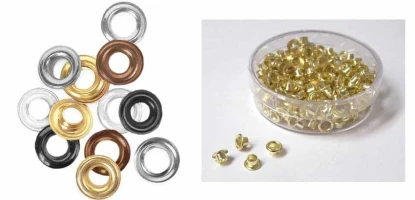
4.5 mm / 0.18 in No. 2 sheet-steel domed eyelet: a practical setting guide
The value of SB 13785 is not just the eyelet itself. With the correct punching and setting dies, it gives workshops a repeatable way to finish small openings without flattening the dome, tearing the material or leaving the eyelet loose. Its 4.5 mm / 0.18 in inner opening and 6 mm barrel height make it a practical No. 2 option for bag, footwear and accessory production.
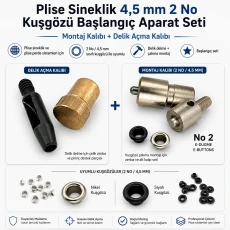
The most reliable way to use this product is to treat the eyelet and tooling as one system. For SB 13785, the verified matches are the KLP0002 setting die and the KLP00020DEL punching die. Planning the eyelet together with the correct tooling prevents many of the problems that show up later in production.
What do you gain by choosing the right setup?
The domed face gives a fuller, more finished look than a flat eyelet. The 4.5 mm opening works well for finer laces, cords and attachment points, while the 6 mm barrel gives the eyelet room to pass through the material and form on the back side. When the hole and press setting are correct, the eyelet sits flatter, rotates less and produces a cleaner finished product.
For a workshop, the bigger benefit is consistency. Once the punching size and press pressure are set correctly, the same setup can be repeated across a production batch with less trial and error. That means fewer rejected pieces and less time spent correcting individual settings.
Why does hole preparation matter so much?
An eyelet can only grip as well as the hole allows. If the hole is too large, the eyelet may rotate or loosen. If it is rough or undersized, the material can bunch, tear or pull the eyelet off center. The KLP00020DEL punching die is the verified hole-preparation tool for this model and helps create a cleaner, more controlled opening.
On leather, synthetic leather and tightly woven textiles, a clean cut is especially important. On very light fabrics, reinforcing the setting area can help prevent the opening from stretching during use.
How does the setting die affect the finished look?
With a domed eyelet, the die does more than apply force. It supports the visible face while the rear barrel forms. The verified KLP0002 setting die matches the No. 2 geometry of SB 13785. A mismatched die can flatten the dome, scratch the finish or produce an uneven rear roll.
If you already own a No. 2 die, test several samples before production. Similar size does not always mean identical geometry.
What changes when you use a press?
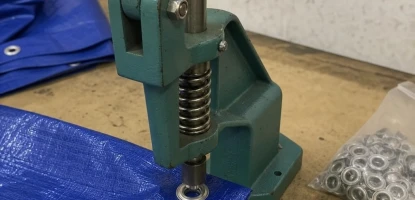
For occasional work, careful manual setting may be possible. For repeated production, a press makes the process easier to control. A machine such as the M0099 hand press, used with the correct die, helps the operator apply similar pressure on every cycle. The goal is not maximum force; it is repeatable force and accurate alignment.
How to set SB 13785
Mark the position first and check total material thickness. Punch a clean opening with KLP00020DEL. Insert the eyelet from the visible side and position the required backing component. Install KLP0002 on the press, center the parts and make the first setting with controlled pressure.
Do not treat the first press stroke as the final production setting. Inspect the dome, the rear roll and the material around the hole. If the eyelet turns by hand or the dome is flattened, adjust before continuing. Once the sample is correct, keep the same setup for the production run.
For bags and accessories
On bags, the eyelet is often both functional and visible. A metal edge around a cord or small attachment point looks more finished than a raw hole and can help protect the material from wear. Flexible synthetic leather or fabric may benefit from local reinforcement to reduce rotation over time.
For footwear and lacing
On footwear, the eyelet protects the lace opening and gives the lace a smoother edge to move against. The lace diameter should be checked against the 4.5 mm opening. On thicker uppers or multilayer constructions, test the 6 mm barrel height before starting a full run.
For labels and textile accessories
Hang tags, textile labels and small accessories often need a clean attachment point for string or cord. A metal eyelet turns a basic punched hole into a more finished connection point. On thin materials, accurate punching and reinforcement become more important because the base material can deform easily.
When is this not the right eyelet?
If your cord or lace does not move freely through a 4.5 mm opening, choose a larger inner diameter. If the material stack is too thick for a 6 mm barrel to form correctly, a longer-barrel eyelet may be more appropriate. For heavy-load technical applications, choose by load and material requirements rather than appearance alone.
Common production problems
The problems we most often see come from oversized holes, the wrong setting die, poor centering or too much press pressure. Another common mistake is keeping the same press setting after changing material thickness. A quick sample check at the start of each material batch can prevent a large amount of rework.
Quick technical reference
| Inner diameter | 4.5 mm / 0.18 in |
| Barrel height | 6 mm |
| Material | Sheet steel |
| Profile | Domed |
| Minimum order | 1,000 pieces |
| Setting die | KLP0002 |
| Punching die | KLP00020DEL |
Frequently asked questions
What is the verified inner diameter?
4.5 mm / 0.18 in. Older 4.8 mm references should not be used.
Which setting die should I buy?
KLP0002 is the verified setting die for this model.
Which punching die should I use?
KLP00020DEL is the verified punching die.
Can I use it with the M0099 hand press?
Yes, when the compatible KLP0002 tooling is fitted and the press is adjusted on a sample first.
Is it suitable for bags and footwear?
Yes, provided the material thickness and lace/cord size fit the application.
What is the minimum order?
1,000 pieces.