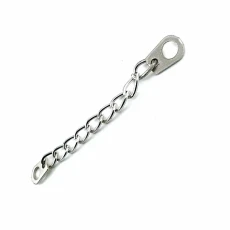
What Are Coat and Jacket Hanger Chains?
Coat and jacket hanger chains are short metal accessories designed to create an internal hanging point in outerwear. They can be used inside coats, jackets, leather jackets, overcoats, uniforms, workwear and selected textile products where the garment needs to hang neatly from a clothes hanger.
The chain is generally positioned near the neckline, upper lining area or a reinforced internal tab. This creates a dedicated hanging point and can help the garment sit more evenly on a hanger. Depending on the product design, the chain can be stitched through square end plates with sewing holes or attached through loop ends to a suitable textile, leather or metal connection point.
These products may also be searched as coat hanger chains, jacket hanging chains, metal garment hanger chains, clothing hanger chains, interior hanger chains or outerwear hanger chains. Their main role is to form a short hanging connection inside a garment. They are not designed as long handbag shoulder chains or decorative bag-carrying chains.
For the wider hardware group, browse bag buckles, rings and hooks. This helps coordinate garment hanger chains with rings, hooks, rivets and other visible metal components used in the same garment or accessory project.
Where Are Garment Hanger Chains Used?
Garment hanger chains are mainly used in outerwear and textile products that need a compact internal hanging solution. The suitable chain length, attachment method and finish should be selected according to the construction of the garment.
- Coats and overcoats: Internal hanging point near the upper lining or neckline area.
- Jackets and leather jackets: Short internal hanging detail for placing the garment on a wardrobe hanger.
- Outerwear and parkas: Hanger-chain system for garments with structured lining or reinforced neckline sections.
- Workwear and uniforms: Functional internal hanging detail for jackets, coats and selected outerwear styles.
- Vests and textile accessories: Compact hanging or connection detail where the product construction supports it.
- Leather and accessory projects: Short decorative or functional chain detail when combined with compatible rings, hooks or leather tabs.
Garment Hanger Chain vs Bag Shoulder Chain
A garment hanger chain is a short internal component used to create a hanging point inside a coat, jacket or similar textile product. A bag shoulder chain is a longer carrying component intended for a handbag, shoulder bag or crossbody bag.
The products in this category are primarily for coats, jackets, outerwear and textile hanger systems. For a bag shoulder-chain project, assess the required carrying length, connection structure, hook type, ring size and intended use as a separate hardware system.
Garment Hanger Chain End Types
Chain length alone is not enough for product selection. The chain-end construction determines how the hanger chain will be attached to the garment. The main structures in this category are loop-end chains and square-end chains with sewing holes.
Loop-End Garment Hanger Chains
Loop-end garment hanger chains have a metal loop at each end. These loops can connect to a narrow textile tab, a stitched connection point, a leather tab, a small metal ring or another compatible fitting. The internal diameter of each loop must fit the physical size of the part that will pass through it.
The available models are associated with 4 mm / 0.16 in, 5 mm / 0.20 in, 6 mm / 0.24 in and 6.5 mm / 0.26 in loop-opening dimensions. Choose the loop size according to the thickness of the textile tab, ring, cord or connection component used in the garment.
Square-End Hanger Chains with Sewing Holes
Square-end hanger chains have flat end plates with sewing holes. They are designed for direct stitching into lining, reinforcement tape, fabric loops or compatible textile sections. This type is suitable where the garment construction requires a flatter and more controlled attachment point.
When choosing a sewing-hole hanger chain, check the end-plate width, hole position, lining thickness and stitching path. Both ends should be attached in a balanced position so the chain sits evenly when the garment is hung.
How to Choose the Correct Garment Hanger Chain Length
Hanger-chain length should be selected according to the available space inside the garment, the neckline shape, the lining structure and the intended hanging position. A chain that is too short may be difficult to place over a hanger hook. A chain that is too long may move too freely inside the garment.
| Chain Length | Approx. Inch | Typical Selection Logic |
|---|
| 7 cm | 2.76 in | Compact jacket constructions, shorter attachment areas and narrow neckline sections. |
| 7.5 cm | 2.95 in | Coats, jackets and leather garments requiring a slightly wider hanging area. |
| 8 cm | 3.15 in | Outerwear with more room around the collar, lining or upper internal construction. |
These length groups provide practical selection guidance, but they do not replace a real fit check. Before production, compare the chain length with the actual garment sample, attachment points and necessary hanger clearance.
Why Does Loop Inner Diameter Matter?
On loop-end hanger chains, the internal diameter of the end loop determines whether the selected attachment component can pass through the chain end correctly. The connection may involve textile tape, narrow webbing, cord, a leather tab, a small ring or another suitable hardware part.
| Selection Point | Why It Matters |
|---|
| Chain Length | Controls the usable space between the garment attachment points and the hanger hook. |
| Loop Inner Diameter | Confirms that the textile tab, ring, cord or fitting can pass through the chain end. |
| End Type | Determines whether the chain is sewn directly, attached through loops or used with another supporting component. |
| Lining or Fabric Thickness | Affects the suitability of stitching, reinforcement and attachment methods. |
| Attachment Position | Helps determine whether the chain will sit correctly near the collar, lining or internal tab. |
| Metal Finish | Helps coordinate the chain with zippers, snap fasteners, rivets and visible metal garment details. |
Build a Compatible Garment Hanger System
A garment hanger chain can work on its own when stitched into a suitable lining area or can be combined with supporting components depending on the garment construction.
- Sewn internal hanger system: Square-end hanger chain + reinforced lining or textile tape.
- Loop-end attachment: Loop-end hanger chain + compatible spring ring or connection ring.
- Leather-tab hanger system: Hanger chain + leather tab + suitable rivets where the construction requires reinforced attachment.
- Coordinated outerwear hardware: Hanger chain + compatible zipper, snap fastener, rivet or metal-label finish.
- Short bag or accessory chain detail: Short chain + compatible D ring, O ring or frame ring.
- Detachable short accessory connection: Chain + compatible snap hook, carabiner clip or swivel hook.
- Reinforced cord or tape pass-through: Suitable eyelets and grommets where the garment or accessory requires a reinforced hole.
How to Choose the Correct Hanger Chain
- Measure the available internal attachment area on the garment.
- Select 7 cm / 2.76 in, 7.5 cm / 2.95 in or 8 cm / 3.15 in according to the garment structure.
- Decide whether the chain should be sewn directly or attached through loop ends.
- Match the loop inner diameter with the textile tab, ring or attachment component.
- Check lining thickness and reinforcement requirements before stitching.
- Coordinate the metal finish with zippers, snap fasteners, rivets and other visible hardware details.
- Confirm that the connection sits comfortably without stressing the surrounding fabric.
- Check package quantity for sampling, repair work or production requirements.
Common Selection Mistakes
- Selecting chain length without measuring the real mounting area.
- Ignoring loop inner diameter when choosing the attachment tab or ring.
- Choosing a loop-end chain where a sewing-hole end is required, or the reverse.
- Planning stitching without considering lining thickness or reinforcement.
- Treating a short garment hanger chain as a long bag shoulder chain.
- Using mismatched metal finishes across zippers, snaps, rivets and hanger-chain hardware.
- Using a garment hanger chain as a lifting, load-bearing or personal-safety component without documented technical suitability.
Frequently Asked Questions
What is a garment hanger chain used for?
A garment hanger chain creates a short internal hanging point in coats, jackets, leather garments and similar outerwear products. It helps the garment hang from a clothes hanger through a dedicated attachment point.
Where are coat hanger chains used?
They can be used in coats, jackets, overcoats, leather jackets, workwear, uniforms, vests and selected textile-accessory projects.
Should I choose a 7 cm, 7.5 cm or 8 cm hanger chain?
Select the length according to the available space near the neckline or lining area. A 7 cm / 2.76 in chain can suit compact attachment areas, while 7.5 cm / 2.95 in and 8 cm / 3.15 in options can suit wider internal sections.
What is a loop-end hanger chain?
A loop-end hanger chain has metal loops at both ends. The loop opening should match the textile tab, ring, cord or connection component used to attach the chain to the garment.
How is a sewing-hole hanger chain installed?
A sewing-hole hanger chain is attached through the holes in its square end plates. It can be stitched to lining, fabric tape or a reinforced textile section after checking the stitching path and material thickness.
Can garment hanger chains be used as bag shoulder chains?
These products are short internal hanger chains for garments. A shoulder-bag project should use a separate chain system selected for its required length, connection structure and intended use.
Which accessories can be used with a garment hanger chain?
Depending on the product construction, compatible spring rings, D rings, O rings, hooks, rivets, leather tabs, eyelets and other garment hardware can be used alongside a hanger chain.

.jpg-40x40.webp "Magnetic Snaps Buttons")

.jpg-40x40.webp "Prong Snap Fasteners for Baby Clothes")


.jpg-40x40.webp "Curved Snaps Buttons")


.jpg-40x40.webp "Snap Fasteners Half Dome type")
-no5-k0010%20(3).jpg-40x40.webp "Eyetlets")


-K0014.png-40x40.webp "Steel Eyelets and Iron Metal Grommets")

.jpg-40x40.webp "Flat Brass Eyelets and Grommets")

.jpg-40x40.webp "Aluminum Eyelets and Grommets")


.jpg-40x40.webp "Galvanized Eyelets and Grommets")


.jpg-40x40.webp "Hole Cutter Tools and Punching Dies")

.jpg-40x40.webp "Grommet Punching Dies")


.jpg-40x40.webp "Pearls Types")


.jpg-40x40.webp "Rivets")


.jpg-40x40.webp "Water-Repellent Jacket Zippers")


.jpg-40x40.webp "Tires")

.jpg-40x40.webp "Round Braided Elastic Cord")


.png-40x40.webp "Enameled Buttons")


.jpg-40x40.webp "Carabiner Clips, Snap Hooks and Bag Hooks")


-PhotoRoom.png-40x40.webp "Spring Rings, Key Rings and Snap Clamps")


.png-40x40.webp "Hook and Eye Closures Sew-On")


.jpg-230x230.webp "Coat Hanger Chain 7 cm Length End Inner Diameter 4 mm Metal E 1721")
.jpg-230x230.webp "Coat Hanger Chain 7.5 cm Length End Inner Diameter 6.5 mm Metal E 1789")
.jpg-230x230.webp "Coat Hanger Chain 7 cm Length 5 mm Metal E 1834")
.jpg-230x230.webp "Coat Hanger Chain 7.5 cm Length Sewing Hole Square End Metal E 1720")
.jpg-230x230.webp "Coat Hanger Chain 8 cm Length End Inner Diameter 6 mm Metal E 361")