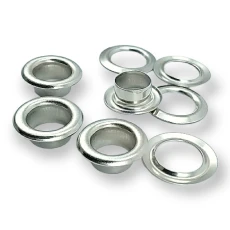
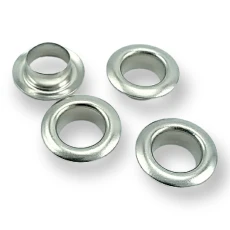
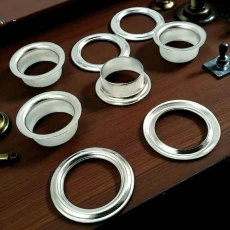
Narrow-rim brass eyelets for bags and garments
E-Buttons offers three narrow-edge brass eyelet models in this category. No. 5 and No. 24 have domed visible rims, while No. 28 is flat. Compare the barrel length and outside diameter before choosing the finish or fitting die. The 5 No inner diameter is consistently shown as 8 mm (0.315 in). The title and description disagree on the inner diameter of No. 24 and No. 28, so those measurements need confirmation before selecting a punch or cord.
Eyelet model and size comparison
| Model | Face | Inside opening | Outside diameter | Barrel |
|---|
| No. 5 | domed | 8 mm / 0.315 in | 13.5 mm / 0.531 in | 5.4 mm / 0.213 in | ERB0005PRDAR |
| No. 24 | domed | 9.5 mm in title, 9.3 mm in description (verify) | 16 mm / 0.630 in | 5.3 mm / 0.209 in | ERB0024PRDAR |
| No. 28 | flat | 13 mm in title, 15.5 mm in description (verify) | 21.5 mm / 0.846 in | 8.3 mm / 0.327 in | ERD0028PRDAR |
Shop the individual models
Choose the eyelet by the cord
A narrow-rim eyelet can give a bag or garment a restrained metal finish around the cord opening. First check the cord, shoe lace or rope that will pass through it. A stiff cord behaves differently from a soft woven lace, even if both are sold under the same nominal size. Try a physical sample before deciding on the opening. The visible inside diameter is not necessarily the hole-punch size used to install the eyelet. The barrel, setting die and finished material thickness must be considered as well. This is particularly important for No. 24 and No. 28 because their product titles and technical descriptions disagree about the inner opening.
No. 5 domed narrow-rim brass eyelet
No. 5 is the smaller domed model in this range. Its title and product description both give an 8 mm (approximately 0.315 in) inside diameter. The technical description lists a 13.5 mm outside diameter and a 5.4 mm barrel length. It may suit a small drawcord opening on a textile bag or a similar leather accessory, provided the surrounding material supports the fastening. The curved rim changes the visible finish of the opening. Check the setting die against this particular narrow-rim shape, and test the eyelet with the cord you intend to use. The product page offers separate plastic and metal washer options; check how these affect the order.
No. 24 domed narrow-rim brass eyelet
No. 24 is also domed, with a listed outside diameter of 16 mm and barrel length of 5.3 mm. The inner diameter needs checking: the title gives 9.5 mm and the detailed description gives 9.3 mm. The difference may be small on a drawing but matters when selecting a hole punch or a close-fitting lace. Neither figure should be presented as a confirmed final inside dimension. Buyers comparing this model with No. 5 can assess the visible rim and available finishes, then request a measured sample before choosing installation equipment. Use the full product code ERB0024PRDAR when making enquiries, since other No. 24 eyelets can have a different rim profile.
No. 28 flat narrow-rim brass eyelet
No. 28 has a flatter visible rim than the two domed models. Its product description lists an outside diameter of 21.5 mm and a barrel length of 8.3 mm. The recorded inside opening is inconsistent: 13 mm in the title, 15.5 mm in the detailed description. This is a material difference for a rope passage or a hole punch. A product sample must be measured before using either figure as the final installation dimension. The listing discusses canvas covers, curtains and tents, but suitability depends on the cord, pull direction and reinforced material. Plastic and metal washer choices are recorded for this product, and the chosen washer may affect the mounting arrangement.
Domed or flat visible rim?
The No. 5 and No. 24 models have a gently curved or domed visible ring. The No. 28 version is described as flat. Compare the metal outline on the actual fabric or leather rather than relying only on the number. The size of the outside flange also affects how much metal surrounds the opening. A smaller eyelet can look more discreet on a narrow bag strap, while a wider ring may suit a cover or panel. A flat profile does not automatically make an eyelet mechanically equivalent to a domed design. A suitable setting die must support the chosen face without damaging it.
Brass body and metal finishes
All three items in this category are described as brass. Brass is the body material; the finish and color options should be checked separately for each product. A nickel-colored surface can look different from gunmetal, also called Black Nickel, or an antique-brass finish. Do not assume that every finish is offered on all three models. Compare the eyelet alongside any matching bag rings, zips or buckles. Finish names do not prove that the parts use identical coatings. On outdoor textiles, assess care and exposure conditions before selecting the finished hardware. The item description alone does not establish a guaranteed surface lifetime.
Barrel length and layered materials
An eyelet barrel passes through the cut material and is formed against the back surface during setting. The No. 5 and No. 24 descriptions give barrel lengths near 5.4 and 5.3 mm respectively, while No. 28 is listed at 8.3 mm. These are product barrel measurements, not universal maximum fabric-thickness ratings. For a lined bag, measure the outer fabric, lining and reinforcement at the actual attachment point. On leather, also allow for the way the layers compress. If the barrel cannot form correctly, the eyelet may loosen or leave a rough edge. Use a trial assembly with the intended washer and setting die.
Hole punching and setting dies
Choosing a punch starts with the eyelet barrel and the setting instructions, not simply the visible inner opening. A punch that is too wide may leave insufficient grip around the metal; a hole that is too small can damage the material during insertion. Check a measured sample and the exact eyelet code. The setting die must also match the rim, barrel and press arrangement. Domed and flat faces may need different supporting profiles. On the first sample, inspect the visible rim for marks and the back for an even formed edge. Avoid starting a large batch until the fit has been tested in the finished material.
Washer options and complete order quantity
A washer supports the back of some eyelet installations. No. 5 and No. 28 product records include plastic and metal washer options, with their own price differences. Do not assume the same choices are offered with No. 24. Check whether the required washer is included or ordered as a selected extra. Product URL wording mentions 500 pieces, but the current order unit and option settings on the product page govern the purchase. A bag using four eyelets needs four completed eyelet positions. For 120 bags, that is 480 eyelets before allowing for fitting trials and waste. Count any required washers separately.
Bags, shoes and leather accessories
On a drawstring bag the lace moves through the eyelet every time the opening is tightened. The metal edge should sit smoothly against the cord, while the fabric around it must tolerate repeated pull. A shoe upper also sees repeated tension through lace holes. For leather goods, the material thickness and its backing are particularly important. A smaller visible rim may suit the design but does not eliminate the need for support. Choose the eyelet position with sufficient distance from seams and edges, fit a complete sample and check the back surface. The right choice depends on the actual material, not on the product number alone.
Curtains, canvas covers and tents
An eyelet in a curtain or canvas cover may carry hooks, ties or tensioned rope. The cord size and the load direction influence the selection. A narrow visible rim is an appearance choice, but the reinforced fabric must still hold the fastening securely. The No. 28 listing refers to curtains, covers and tents. Because its reported inner diameter is inconsistent, measure the actual item before selecting a corresponding rope or punch. A completed trial installation should be pulled in the expected direction and examined for movement or tearing. Exterior use also calls for attention to cleaning and environmental exposure.
Checking the finished sample
After setting an eyelet, inspect the front to confirm that the rim remains even and unmarked. The metal on the back should be formed smoothly without a sharp or uneven edge. Pass the planned cord through the opening and apply the type of movement expected during use. Check whether the eyelet turns in its mounting hole, whether fibres pull away from the rim, or whether the material puckers. If the result is unsatisfactory, review the setting die, hole size and material layers before adjusting pressure. Keep the accepted sample with the SKU, finish and washer choice for future orders.
Choosing between the three models
Start with the shape of the visible rim: No. 5 and No. 24 are domed, while No. 28 is flat. Then assess the outside diameter, barrel length and the intended cord. The 5 No opening is consistently described as 8 mm. The No. 24 and No. 28 inside openings remain unresolved in the product records, so precise diameter decisions for those two require measurement. The product code distinguishes these narrow-edge designs from other eyelets sold under the same number. Once the sample has been approved, order the color and quantity that matches the production plan. Check compatible washers and setting tools as separate parts of the decision.
Frequently asked questions
What is a narrow-rim eyelet?
It is an eyelet with a slimmer visible metal flange around a cord or lace opening.
How many styles are in this category?
The range includes domed No. 5 and No. 24 models and a flat No. 28 model, all described as brass.
What is the No. 5 inside diameter?
The title and technical description agree on 8 mm, approximately 0.315 in.
Is the No. 24 inside diameter 9.3 or 9.5 mm?
The detailed description states 9.3 mm while the title states 9.5 mm. Confirm by measurement.
Is the No. 28 inside diameter 13 or 15.5 mm?
The title states 13 mm while the detailed description states 15.5 mm. Confirm by measurement.
Is the eyelet inner diameter the punch diameter?
Not necessarily. The punch must be selected for the barrel, setting system and actual material.
Can I use a flat-eyelet die on a domed rim?
Compatibility must be checked; a different face profile may require another die.
What materials are these eyelets made from?
All three are listed as brass. Surface finish options vary by product.
Are washers available?
Plastic and metal washer choices appear in the records for No. 5 and No. 28.
Are the eyelets sold in 500-piece packs?
The product URLs mention 500 pieces. Check each live selling unit and option before purchase.
Can they be used in shoes?
A suitable sample can be tested against the shoe upper, lace and expected pulling load.
Can No. 28 be used for canvas covers?
The product description lists covers and tarpaulins as applications, subject to verified measurements and fitting.
What is the barrel length of No. 5?
Its detailed description lists 5.4 mm, approximately 0.213 in.
How do I check the installed eyelet?
Inspect the front, formed back and the surrounding material, then test with the intended cord.
How do I repeat an order correctly?
Keep the model code, finish, measured size, washer choice and setting die reference with the approved sample.