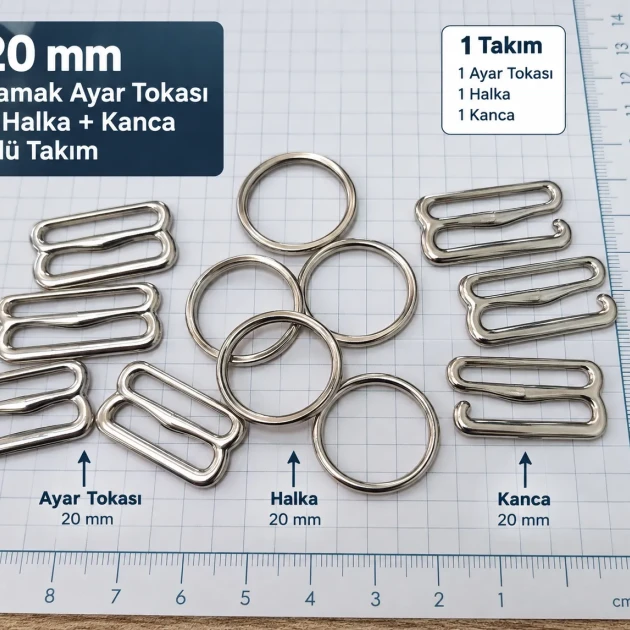
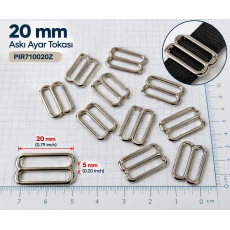
20 mm / 0.79 in Zamak Bra Strap Slider, Ring and Hook 3-Piece Set is a coordinated 20 mm / 0.79 in Zamak hardware 3-piece set for wider bra, bralette and swimwear straps. It contains 3 separate metal pieces: 1 standard slider + 1 ring + 1 hook. On e-buttons, the set is structured for buyers who want the primary hardware for one strap recipe under a single purchasing item while keeping the individual component functions clear.
Understanding the 20 mm / 0.79 in set
The nominal size describes the strap-width class, not a universal fit guarantee. Tape thickness, weave density, surface friction, elasticity and folded construction can all change how the metal pieces behave. Every component in the set should therefore be tested with the actual production tape. If the tape binds, bunches, feels excessively loose or causes unwanted rotation, review the combination before bulk production.
Reading the package count correctly
The set is one commercial item but contains 3 separate physical metal components: 1 standard slider + 1 ring + 1 hook. Purchasing, warehouse and production teams should distinguish set quantity from individual-piece quantity. A 500-set order requires the correct number of each component according to the set recipe. Keeping this distinction clear reduces inventory and consumption errors.
Standard-body 20 mm / 0.79 in set
This set uses the standard-body slider. A wide-body alternative exists in the same nominal strap class, so a generic “20 mm set” label is not specific enough for repeat production. Keep standard and wide-body versions under distinct product codes to preserve the approved construction.
What the hook adds to the set
The three-piece version adds a hook to the slider-and-ring combination. It can be used in constructions that require a hook-style detachable or connecting point. The mating geometry varies by garment design, so the presence of a hook in the set does not guarantee automatic compatibility with every counterpart. Verify the hook, mating point and real tape together on a sample.
Different functions inside one strap system
The slider controls usable strap length and the ring provides a connection and direction-change point. The hook provides the hook-style connection required by the design. Equal nominal width does not make these pieces interchangeable. The technical pack should identify the role of each component so assembly operators do not substitute one function for another.
Zamak material classification
The metal components are classified as Zamak. That describes the material family; it does not by itself establish coating life, corrosion resistance, wash durability or chemical resistance. If a garment program has specific performance requirements, confirm them through separate test results or quality documentation instead of assuming them from material name alone.
Use in bras, bralettes and swimwear
The 20 mm / 0.79 in class can be used in wider bra, bralette, bikini and swimwear strap constructions. Final suitability depends on the complete design. Swimwear and lingerie tapes can differ significantly in stretch, thickness and surface behavior, so the same metal set should be rechecked whenever the strap material changes.
Tape routing and seam placement
Seams near the slider should leave enough room for the intended adjustment movement. Folds around the ring should sit flat without excessive bulk. At the hook, confirm strap direction and mating geometry together. Seam distance should follow the approved sample rather than a generic rule that ignores the actual tape construction.
Finish options
The family uses Nickel, Black Nickel and Gold finish options. Planning all pieces of the set under the same finish supports visual consistency on the completed strap. A finish shown with zero option stock should not be treated as immediately available inventory. Check current option quantity before committing a production schedule.
Purchasing and warehouse control
Ordering a set simplifies component planning when the same pieces are used together in production. At receiving, verify set type, nominal size and piece count. Once packages are opened, do not mix the parts with nearby sizes. Standard-body and wide-body sets should remain in separately labeled bins to reduce picking errors.
Repeat orders across a collection
The same approved set may be used across multiple garment sizes or colorways when the strap construction remains equivalent. If tape supplier, thickness or elasticity changes, perform a short verification sample instead of automatically extending the previous approval. Use the product code and set type together on repeat purchase orders.
Quality-control checkpoints
Incoming inspection can confirm the correct model, complete piece count, absence of obvious deformation and the ordered finish. Pre-production sampling should then check tape routing, movement, component orientation and the appearance of the finished strap. This keeps quality control focused on observable production fit rather than unsupported technical performance claims.
Preventing size and set mix-ups
Hardware in 18 mm, 20 mm and 22 mm classes can appear similar at a glance. Standard and wide-body sliders may also be confused when only finish color is considered. Use size, product code and set type together on bin labels and work orders. Do not release material to production based on appearance alone.
First-piece inspection
Compare the first completed straps in a production run with the approved reference sample. Look for tape twisting, unwanted hardware rotation, excessive play and restricted adjustment. If a difference appears, review the tape and sewing process as well as the metal components before continuing the run. The strap system should be evaluated as a whole.
Inventory and consumption planning
The minimum order is 500 sets. Actual purchasing quantity should account for set consumption per garment, sampling requirements, the company’s own quality-reject history and any internal safety stock. Store quantity tiers are commercial price levels and should not be interpreted as a recommended production-loss allowance.
Repeat-order traceability
Use product code, 20 mm / 0.79 in size, standard-body designation and set type together on repeat orders. A generic “20 mm bra hardware set” description is not specific enough when multiple variants exist. Matching terminology across technical packs and purchase orders helps preserve the previously approved combination.
Short selection guide for production teams
First confirm the strap width and construction, then confirm whether the design requires a hook-style connection in addition to slider and ring. Keep the standard slider distinct from the wide-body alternative. Finish the process by building a complete sample with the actual tape before approving bulk production.
Production planning by set
Commercial set quantity should be separated from physical component consumption. Sampling, first-piece approval and internal quality-reject allowances can be planned independently. This gives sourcing and production teams a clearer view of how many coordinated hardware sets are actually required.
Clear naming on bins and work orders
A generic “20 mm set” label is not specific enough. Standard-body or wide-body designation, two-piece or three-piece structure and product code should appear together. Using the same wording in purchasing and production records reduces substitution errors.
When re-sampling is needed
Build a quick new sample when strap supplier, thickness, elasticity, surface texture, fold construction or sewing method changes. Nominal 20 mm / 0.79 in width can remain unchanged while actual hardware behavior changes.
Component direction and assembly order
Correct components can still fail to behave as intended when installed in the wrong direction or sequence. Keep an approved sample available on the line so operators can visually confirm strap routing and component orientation.
Repeat-order traceability
Keep product code, set type, nominal size, material and finish together in the technical record. An approved sample or production image can support that record and reduce the chance of later substituting a visually similar but different set.
Final batch-preparation note
Before hardware is released to production, compare piece count, finish and the 20 mm / 0.79 in size against the work order. Confirm whether the approved version is standard-body or wide-body. Leftover components from opened packages should remain labeled with their original product code so they are not later used to complete a different set. This simple control improves warehouse counting and repeat-order accuracy.
Frequently Asked Questions
How many physical pieces are in the set?
3 pieces: 1 standard slider + 1 ring + 1 hook.
What is the nominal size?
The set is intended for the 20 mm / 0.79 in strap class.
What is the material?
The set components are classified as Zamak.
What is the minimum order?
The minimum order is 500 sets.
Should the set be sampled with the real tape?
Yes. Tape thickness, stretch, folding and seam construction can affect how the components behave.
Is this the same as the wide-body set?
No. This set uses the standard-body slider; the wide-body set is a separate product.
Is the hook automatically compatible with every garment connection?
No. The mating point and strap orientation should be verified on the actual sample.

.jpg-40x40.webp "Magnetic Snaps Buttons")

.jpg-40x40.webp "Prong Snap Fasteners for Baby Clothes")


.jpg-40x40.webp "Curved Snaps Buttons")


.jpg-40x40.webp "Snap Fasteners Half Dome type")
-no5-k0010%20(3).jpg-40x40.webp "Eyetlets")


-K0014.png-40x40.webp "Steel Eyelets and Iron Metal Grommets")

.jpg-40x40.webp "Flat Brass Eyelets and Grommets")

.jpg-40x40.webp "Aluminum Eyelets and Grommets")


.jpg-40x40.webp "Galvanized Eyelets and Grommets")


.jpg-40x40.webp "Grommet Punching Dies")
.jpg-40x40.webp "Hole Cutter Tools and Punching Dies")


.jpg-40x40.webp "Pearls Types")


.jpg-40x40.webp "Rivets")


.jpg-40x40.webp "Water-Repellent Jacket Zippers")


.jpg-40x40.webp "Tires")

.jpg-40x40.webp "Round Braided Elastic Cord")


.png-40x40.webp "Enameled Buttons")


.png-40x40.webp "Two Hole Sewing Buttons")


.jpg-40x40.webp "Carabiner Clips, Snap Hooks and Bag Hooks")


-PhotoRoom.png-40x40.webp "Spring Rings, Key Rings and Snap Clamps")


.png-40x40.webp "Hook and Eye Closures Sew-On")



.webp-630x630h.webp "20 mm / 0.79 in Zamak Bra Strap Slider, Ring and Hook 3-Piece Set PIR770020Z")
.webp-630x630h.webp "20 mm / 0.79 in Zamak Bra Strap Slider, Ring and Hook 3-Piece Set PIR770020Z")
.webp-630x630h.webp "20 mm / 0.79 in Zamak Bra Strap Slider, Ring and Hook 3-Piece Set PIR770020Z")
.webp-630x630h.webp "20 mm / 0.79 in Zamak Bra Strap Slider, Ring and Hook 3-Piece Set PIR770020Z")
.webp-630x630h.webp "20 mm / 0.79 in Zamak Bra Strap Slider, Ring and Hook 3-Piece Set PIR770020Z")
.webp-80x80w.webp "20 mm / 0.79 in Zamak Bra Strap Slider, Ring and Hook 3-Piece Set PIR770020Z")
.webp-80x80w.webp "20 mm / 0.79 in Zamak Bra Strap Slider, Ring and Hook 3-Piece Set PIR770020Z")
.webp-80x80w.webp "20 mm / 0.79 in Zamak Bra Strap Slider, Ring and Hook 3-Piece Set PIR770020Z")
.webp-80x80w.webp "20 mm / 0.79 in Zamak Bra Strap Slider, Ring and Hook 3-Piece Set PIR770020Z")
.webp-80x80w.webp "20 mm / 0.79 in Zamak Bra Strap Slider, Ring and Hook 3-Piece Set PIR770020Z")

.webp-230x230.webp "20 mm / 0.79 in Zamak Bra Strap Ring PIR720020Z")
.webp-230x230.webp "20 mm / 0.79 in Zamak Bra Strap Hook PIR750020Z")
.webp-230x230.webp "10 mm Zamak Mayo Model Sütyen Askı Ayar Tokası PIR711010Z")
.webp-230x230.webp "10 mm Zamak Mayo Model Sütyen Askı Ayar Tokası ve Halkası 2'li Set PIR701010Z")
.webp-230x230.webp "10 mm Zamak Mayo Model Sütyen Askı Ayar Tokası, Halkası ve Kancası 3'lü Takım PIR771010Z")
.webp-230x230.webp "10 mm Zamak Sütyen Askı Ayar Tokası, Halkası ve Kancası 3'lü Takım PIR770010Z")
.webp-230x230.webp "10 mm Zamak Sütyen Askı Halkası PIR720010Z")
.webp-230x230.webp "10 mm Zamak Sütyen Kancası PIR750010Z")