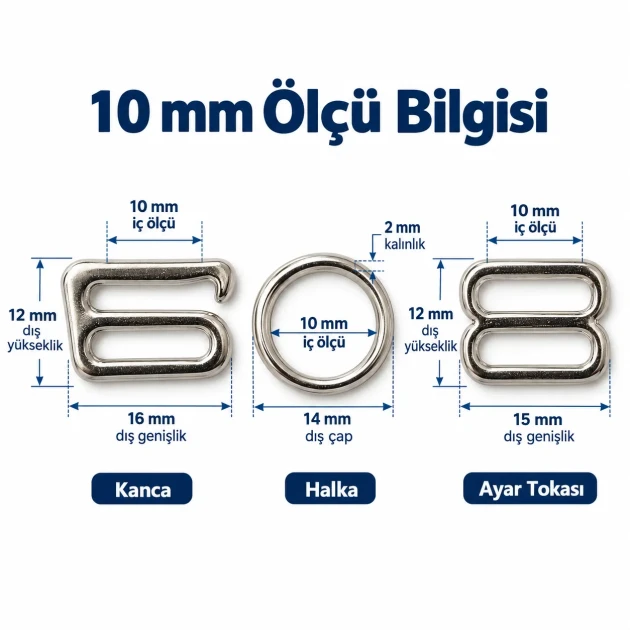
10 mm / 0.39 in Zamak Bra Strap Slider, Ring and Hook 3-Piece Set groups three matching metal components for lingerie and swimwear production. Each set contains one slider, one ring and one hook. The slider adjusts strap length, the ring organizes a connection or direction-change point, and the hook completes the attachment.
Production use of the 3-piece set
When all three parts are required in the same garment, a single set can simplify sourcing and stock control. The set should still match the approved strap construction.
Set contents and counting
One set equals three physical components. An order of 500 sets means 500 sliders, 500 rings and 500 hooks. Warehouse planning should distinguish set count from total piece count.
10 mm / 0.39 in size family
The components share the same nominal hardware family. Real fit depends on strap thickness, elasticity, fold method and hook geometry, so the complete assembly should be sample-tested.
Zamak material classification
All three parts are classified as Zamak. Material, size and component type are kept separate for accurate catalog filtering. Unverified coating or durability claims are not added.
Applications
The set can be used in bra, bralette, bikini, swimwear, bodysuit and similar strap constructions where a hook connection is part of the design. If no hook is used, a 2-piece set may be more appropriate.
2-piece versus 3-piece
The 2-piece set includes slider and ring. The 3-piece set adds the hook. Choose according to the actual garment construction rather than selecting by component count alone.
Live category and alternatives
Browse the live Bra Rings, Hooks and Strap Adjustment Buckles category for broader comparison. The live 8 mm / 0.31 in Zamak 3-piece set provides a useful size comparison.
For a different construction in the same nominal size class, the live 10 mm / 0.39 in metal/nylon-coated 3-piece set can also be reviewed. It is a different material/construction and should not be treated as an automatic substitute.
Sample checks
Check strap movement through the slider, ring angle and folded strap thickness, then confirm that the hook engages the intended counterpart. The complete strap path should be approved before bulk production.
Quality-control checklist
- Confirm all three pieces are present.
- Verify the 10 mm / 0.39 in size family.
- Test the actual strap through the full hardware path.
- Check each component for visible deformation.
- Confirm Zamak in purchasing records.
Signs of mismatch
Binding at the slider, excessive play at the ring, poor hook engagement or unstable strap geometry are reasons to recheck the system.
Purchasing planning
The minimum order is 500 sets. If several garment styles use the same confirmed set, demand can be combined in one purchasing plan.
Changing from 8 mm / 0.31 in to 10 mm / 0.39 in
A wider strap can alter fold allowances, stitching positions and visual scale. A production specification approved for the narrower family should be rechecked with the wider size.
Three-piece set selection on e-buttons
This 10 mm / 0.39 in Zamak package contains one bra strap slider, one ring and one hook. It is intended for constructions that use all three hardware functions together. When the hook is not part of the garment design, a two-piece slider-and-ring set can avoid unnecessary inventory. When components are consumed at different rates, single-item sourcing may provide more flexibility.
Test the complete assembly, not only the parts
Slider movement, ring angle and hook engagement should be checked on one finished sample using the actual production tape. Tape thickness, edge firmness, stretch and folded construction can change how the system behaves. The nominal 10 mm / 0.39 in size identifies the family, but final production approval should come from the assembled strap.
Warehouse counting for a three-piece set
A set is one sales unit but three physical components. Inventory teams should keep the set count separate from the physical component count so purchasing, picking and production consumption remain consistent. Single sliders, rings and hooks should remain separate stock items when they are also sold or used independently.
First-run and repeat-order verification
Compare the first completed production straps with the approved sample. Confirm component orientation, tape path and seam positions before the full quantity is completed. For repeat orders, keep the component type, 10 mm / 0.39 in size family, Zamak material and package contents together in the technical and purchasing records.
Frequently Asked Questions
What is included?
One slider, one ring and one hook.
What does 10 mm / 0.39 in mean?
It identifies the shared hardware size family.
What material are the parts?
Zamak.
What is the minimum order?
500 sets.
How is it different from the 2-piece set?
The 3-piece set also contains the hook.
A practical method for selecting strap hardware
The safest way to select lingerie and swimwear hardware is to evaluate the component as part of the real production system rather than by catalog name alone. Size, material and component type should be read together. The 10 mm / 0.39 in value defines the nominal size family, Zamak defines the material classification, and the product type explains the function within the strap path.
Using the model code on purchasing and production documents also improves continuity. Once a sample is approved, keeping the exact model code on the bill of materials reduces the risk of replacing the component with a visually similar but functionally different item.
Evaluating the strap tape and hardware together
Strap width is only one variable. Thickness, elasticity, weave density and edge firmness can all change the way a tape interacts with metal hardware. A soft elastic may compress easily through a component, while a denser tape with the same nominal width may require more clearance. The real production tape should therefore be part of the approval process.
Sample testing should also include the strap under realistic tension. The angle of hardware can change when a bra or swimsuit is worn, and nearby stitching or folded tape sections can influence the final position.
Approving size during product development
For a new garment, the strap tape and hardware should be developed as one system. If an existing collection changes strap width, previously approved hardware should not automatically be reused. Moving from 8 mm / 0.31 in to 10 mm / 0.39 in requires a review of every connected component and the relevant fold and stitch positions.
Consistent size terminology should be shared by design, sampling, purchasing and production teams. Technical sheets, purchase orders and warehouse labels should use the same model code and size family.
Repeatability in bulk production
A component is truly suitable only when the approved behavior can be repeated in production. If the elastic supplier, tape construction or finishing process changes, the hardware fit should be checked again. The nominal width may remain the same while the real material behavior changes.
Orientation during sewing or assembly can also matter. Keeping an approved reference sample available to the production team helps clarify how small hardware pieces should be routed and positioned.
Information to verify before purchasing
- Model code and component type
- 10 mm / 0.39 in size family
- Zamak material classification
- Single component or set structure
- Physical contents of a set
- Minimum order quantity
- The actual strap tape used in production
Checking these items together reduces many common size and component-selection errors. For set products, remember that 500 sets and 500 physical pieces do not mean the same thing; package content should always be read.
Moving the correct component from warehouse to production
Warehouse labels should identify model code and component type so rings, sliders and hooks with similar dimensions are not mixed. Production material should not be selected by visual similarity alone. A small dimensional difference can change the way a narrow strap moves or connects.
Model-code continuity is also useful for repeat orders, revisions and returns. Reordering only by a generic phrase such as “10 mm buckle” increases the risk of receiving a different component type.
Moving from sample approval to bulk production
After the sample is approved, the strap tape, hardware model and assembly method should be recorded on the technical sheet. If any of these elements changes during bulk production, a short verification sample is more reliable than assuming the original approval still applies.
How to read product attributes
Material, size, application, package content and component type answer different purchasing questions. Package content explains what is physically included in one sales unit, while minimum order quantity explains how many sales units must be ordered. The two should not be confused.
Define the 10 mm / 0.39 in 3-piece set clearly in the bill of materials
On e-buttons, this product is a three-component strap-hardware set containing one slider, one ring and one hook. Each piece performs a different function, so purchase orders should use the full component description, nominal size and Zamak material rather than a vague label such as “10 mm set.” Clear naming helps separate complete sets from single components of the same nominal width and makes warehouse picking easier to verify.
Build the sample with the actual production strap
The nominal 10 mm / 0.39 in size identifies the family, but tape thickness, stretch, surface texture and folded construction can influence all three components. Review slider movement, ring orientation and hook engagement on one completed strap sample. Stitching should not force the hardware out of position, and the tape should not bunch, twist or bind. This practical sample check confirms the real construction without making unsupported performance claims.
Set counting and inventory control
One set represents three physical hardware pieces. Five hundred sets therefore represent five hundred sliders, five hundred rings and five hundred hooks. Set inventory should remain separate from single-component stock. Production planning should use the actual number of sets consumed per finished garment, while requirements shared across several sizes or colorways can be consolidated only when the approved hardware specification is the same.
Use an approved reference for repeat orders
Keeping an approved strap sample or a clear reference image in the technical file helps later teams verify component orientation, tape routing and stitch placement. If the tape supplier or construction changes, previous approval should not automatically be assumed to remain valid. A short recheck is appropriate before a large run continues. Coating performance, corrosion resistance and wash durability should be treated as separate specifications unless they have been verified.
What e-buttons buyers receive in one 3-piece set
One 10 mm / 0.39 in Zamak set contains one bra strap slider, one ring and one hook. The three parts are supplied together but perform different functions in the strap construction. The set format is most practical when all components are required in the same ratio for the same garment style.
Build one complete sample before production
Use the actual production tape and assemble the slider, ring and hook in their intended positions. Move the slider through several adjustment settings, review the ring angle and verify hook engagement with the real mating point. This system-level sample provides more useful approval information than inspecting the components individually.
Watch folded tape and seam relationships
Folded elastic can become substantially thicker than one flat layer. Seam placement near the slider can restrict movement, while seams near the ring or hook can change connection geometry. Record the approved fold allowances and stitch distances after sampling so production can reproduce the same strap construction consistently.
Separate set inventory from single components
The 3-piece set should remain a distinct stock item even when single 10 mm sliders, rings and hooks are also available. One set equals three physical pieces, so set counts and piece counts should not be mixed. Clear warehouse labels and bill-of-material descriptions reduce picking errors and make repeat ordering easier.
Recheck after tape-lot changes
A new tape supplier or production lot can change thickness, surface friction or stretch without changing the nominal width. Previous approval should therefore be verified with the current tape before a large production run. Compare slider movement, ring orientation and hook engagement with the archived reference sample.

.jpg-40x40.webp "Magnetic Snaps Buttons")

.jpg-40x40.webp "Prong Snap Fasteners for Baby Clothes")


.jpg-40x40.webp "Curved Snaps Buttons")


.jpg-40x40.webp "Snap Fasteners Half Dome type")
-no5-k0010%20(3).jpg-40x40.webp "Eyetlets")


-K0014.png-40x40.webp "Steel Eyelets and Iron Metal Grommets")

.jpg-40x40.webp "Flat Brass Eyelets and Grommets")

.jpg-40x40.webp "Aluminum Eyelets and Grommets")


.jpg-40x40.webp "Galvanized Eyelets and Grommets")


.jpg-40x40.webp "Grommet Punching Dies")
.jpg-40x40.webp "Hole Cutter Tools and Punching Dies")


.jpg-40x40.webp "Pearls Types")


.jpg-40x40.webp "Rivets")


.jpg-40x40.webp "Water-Repellent Jacket Zippers")


.jpg-40x40.webp "Tires")

.jpg-40x40.webp "Round Braided Elastic Cord")


.png-40x40.webp "Enameled Buttons")


.png-40x40.webp "Two Hole Sewing Buttons")


.jpg-40x40.webp "Carabiner Clips, Snap Hooks and Bag Hooks")


-PhotoRoom.png-40x40.webp "Spring Rings, Key Rings and Snap Clamps")


.png-40x40.webp "Hook and Eye Closures Sew-On")



.webp-630x630.webp "10 mm / 0.39 in Zamak Slider Ring Hook 3-Piece Set | e-buttons")
.webp-630x630.webp "10 mm / 0.39 in Zamak Slider Ring Hook 3-Piece Set | e-buttons")
.webp-630x630.webp "10 mm / 0.39 in Zamak Slider Ring Hook 3-Piece Set | e-buttons")
.webp-630x630.webp "10 mm / 0.39 in Zamak Slider Ring Hook 3-Piece Set | e-buttons")
.webp-630x630.webp "10 mm / 0.39 in Zamak Slider Ring Hook 3-Piece Set | e-buttons")
.webp-630x630.webp "10 mm / 0.39 in Zamak Slider Ring Hook 3-Piece Set | e-buttons")
.webp-630x630.webp "10 mm / 0.39 in Zamak Slider Ring Hook 3-Piece Set | e-buttons")
.webp-630x630.webp "10 mm / 0.39 in Zamak Slider Ring Hook 3-Piece Set | e-buttons")
.webp-630x630.webp "10 mm / 0.39 in Zamak Slider Ring Hook 3-Piece Set | e-buttons")
.webp-80x80.webp "10 mm / 0.39 in Zamak Slider Ring Hook 3-Piece Set | e-buttons")
.webp-80x80.webp "10 mm / 0.39 in Zamak Slider Ring Hook 3-Piece Set | e-buttons")
.webp-80x80.webp "10 mm / 0.39 in Zamak Slider Ring Hook 3-Piece Set | e-buttons")
.webp-80x80.webp "10 mm / 0.39 in Zamak Slider Ring Hook 3-Piece Set | e-buttons")

.webp-80x80.webp "10 mm / 0.39 in Zamak Slider Ring Hook 3-Piece Set | e-buttons")
.webp-80x80.webp "10 mm / 0.39 in Zamak Slider Ring Hook 3-Piece Set | e-buttons")
.webp-80x80.webp "10 mm / 0.39 in Zamak Slider Ring Hook 3-Piece Set | e-buttons")
.webp-80x80.webp "10 mm / 0.39 in Zamak Slider Ring Hook 3-Piece Set | e-buttons")
.webp-80x80.webp "10 mm / 0.39 in Zamak Slider Ring Hook 3-Piece Set | e-buttons")
.webp-230x230.webp "10 mm Zamak Sütyen Askı Halkası PIR720010Z")
.webp-230x230.webp "10 mm Zamak Sütyen Kancası PIR750010Z")
.webp-230x230.webp "11 mm / 0.43 in Zamak Bra Strap Hook PIR750011Z")
.webp-230x230.webp "11 mm / 0.43 in Zamak Bra Strap Ring PIR720011Z")
.webp-230x230.webp "11 mm / 0.43 in Zamak Bra Strap Slider and Ring 2-Piece Set PIR700011Z")
.webp-230x230.webp "11 mm / 0.43 in Zamak Bra Strap Slider PIR710011Z")