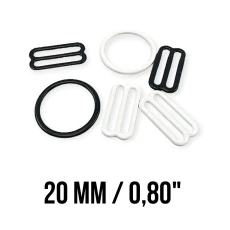
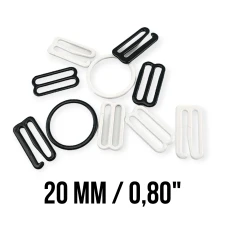
20 mm / 0.79 in Zamak Bra Strap Ring is part of the 20 mm / 0.79 in Zamak bra-hardware family used for wider lingerie and swimwear straps. It is intended to create a strap connection and direction-change point. For production approval, the metal component should be reviewed together with the real elastic or strap tape, seam placement and the other connection points in the finished assembly.
Understanding the 20 mm / 0.79 in size class
The nominal size describes the strap-width class, but production behavior is also affected by tape thickness, weave density, edge firmness, elasticity and folded construction. Two tapes with the same nominal width can move differently through the same metal component. A physical sample is therefore part of responsible approval.
Role of the ring in a strap system
A ring does not adjust strap length. It provides a connection and direction-change point between strap sections. The actual fit depends on tape width, folded thickness and the angle at which the strap enters and leaves the ring. Those factors should be checked on a complete sample.
Zamak construction
The product is classified as Zamak hardware. That identifies the material family; it does not by itself establish coating life, corrosion resistance, wash performance or chemical resistance. If those properties are important for a specific garment program, they should be confirmed through separate quality documentation or testing.
Use in lingerie and swimwear straps
The 20 mm / 0.79 in class can be used in bras, bralettes, swimwear and bikini strap constructions where the design calls for wider hardware. Final suitability depends on the complete strap system, not the metal piece alone. Tape routing, fold allowance, seam direction and neighboring components should all be reviewed together.
Why nominal width is not enough
A 20 mm tape can be dense and firm, soft and compressible, or highly elastic. These differences affect routing, movement and how the hardware sits on the finished strap. If the tape binds, folds, rotates unexpectedly or feels excessively loose, review the component-tape combination before bulk production.
Sourcing and warehouse control
Do not store the 20 mm / 0.79 in component under a generic label with nearby 18 mm or 22 mm sizes. A label that includes both product type and nominal size reduces picking errors. Repeat orders should use the complete hardware description rather than a general “bra strap part” name.
Using one component across a collection
The same approved hardware can be shared across multiple colors or garment sizes when the strap construction remains technically equivalent. If tape supplier, thickness or elasticity changes, build a short verification sample instead of assuming the previous approval automatically carries over.
Sewing and assembly considerations
Keep nearby seams far enough from the hardware to preserve the intended movement and strap path. Fold allowance and free-tape length should follow the approved sample. When several similar sizes are used in the same facility, a physical reference sample can help operators identify the correct component and orientation.
Finished-garment checks
After assembly, inspect the strap for twisting, bunching, unwanted hardware rotation and restricted movement. Review the complete strap system rather than only the metal piece. First production pieces can be compared with the approved sample before the run continues.
Finish options
The family uses Nickel, Black Nickel and Gold finish options. A listed finish with zero option stock should not be interpreted as immediately available inventory. Check the selected option quantity when planning production or repeat orders.
Minimum order and quantity pricing
The minimum order is 500 pieces. Quantity-based group pricing is defined for higher order tiers. This description does not publish or explain the commercial pricing policy; the current price shown by the system at order time is the applicable reference.
Avoiding selection errors
Do not confuse 20 mm / 0.79 in hardware with nearby 18 mm or 22 mm sizes, a standard slider with a wide-body slider, or the function of a ring or hook with an adjustment slider. Checking product name, code and approved sample together reduces sourcing and warehouse errors.
Repeat-order traceability
For repeat purchasing, retain product code, hardware type, nominal size and Zamak material in the order record. A generic description such as “20 mm metal part” is not specific enough. The same naming should appear in the technical pack and warehouse label.
Quality-control approach
Receiving inspection can confirm the correct hardware type, overall form and the absence of obvious deformation. Functional approval should then use the actual production tape. No unsupported surface-life or service-life promise is included here; program-specific quality requirements should be documented separately.
Selection summary for production teams
20 mm / 0.79 in Zamak Bra Strap Ring should be approved as part of a complete 20 mm / 0.79 in strap construction. Correct size class, correct hardware function and the approved assembly method need to align. Evaluating the item with the other 20 mm family components on e-buttons makes coordinated sourcing easier.
Thinking in complete 20 mm / 0.79 in systems
A strap assembly may combine a slider, ring, hook and alternate body styles from the same nominal size family. Matching width does not mean every component performs the same function. The bill of materials should state the role of each piece so production teams can distinguish adjustment, connection and hook functions during assembly.
Checking size with the real production tape
The 20 mm / 0.79 in label describes nominal width, but actual fit also depends on tape thickness and the volume created after folding. Elastic stretch and surface texture can change movement through or around metal hardware. A ruler check is useful at receiving, but functional approval should use the real tape and intended seam construction.
Keeping assembly orientation consistent
Correct hardware can still create a poor result if it is reversed or if the tape follows the wrong path. Keep an approved physical sample or clear production image available at the line. Operators should compare orientation and routing against that reference rather than relying only on memory, especially when several similar components are used in one facility.
Coordinating finish with the garment
Nickel, Black Nickel and Gold are visual finish options within the same product family. Review the selected finish next to the actual strap and garment fabric because contrast can change the perceived prominence of the metal part. A finish listed with zero option stock should not be treated as immediately available without checking current inventory.
Basic incoming inspection
Receiving checks can confirm product model, nominal size, quantity and the absence of obvious deformation. A small sample can then be tested with the approved production tape. This approach focuses on observable production suitability rather than making unsupported claims about coating life, corrosion resistance or mechanical load performance.
Repeat-order identification
For repeat sourcing, use product code, 20 mm / 0.79 in size class and hardware type together. A photograph or generic product label may not be sufficient when nearby sizes and similar shapes exist in the catalog. Consistent naming between the technical pack and purchase order improves traceability to the previously approved component.
From first-piece approval to bulk production
Compare the first completed straps from a production run with the approved sample. Look for tape twisting, excess play at connection points, unwanted hardware rotation or seams that restrict movement. If a difference appears, review tape and sewing conditions as well as the metal component before deciding on corrective action.
Sharing hardware across sizes and styles
The same 20 mm / 0.79 in component can sometimes be used across multiple garment sizes or colorways. That should only be assumed when the strap construction is technically equivalent. If strap length, attachment point or sewing method changes, perform a quick verification rather than extending one sample approval to every style automatically.
Inventory planning
The minimum order is 500 pieces, but purchasing quantity should reflect the actual production plan. Component consumption per garment, sampling needs and the company’s own quality-reject history can be included in planning. The store’s quantity tiers are commercial order levels and should not be interpreted as a production-loss standard.
Preventing mix-ups inside the 20 mm range
Keep 18 mm, 20 mm and 22 mm hardware in separately labeled bins. Standard-body and wide-body sliders should also remain distinct records. Labels that include size and product code help both warehouse and production teams avoid selecting a visually similar but technically different component.
Frequently Asked Questions
What is the nominal size?
It belongs to the 20 mm / 0.79 in bra strap hardware class.
Does the ring adjust strap length?
No. It provides a connection and direction-change point.
What is the material?
The product is classified as Zamak.
What is the minimum order?
The minimum order is 500 pieces.
Should it be tested with the real tape?
Yes. Tape thickness and folded construction can affect the connection.
Is it automatically compatible with nearby sizes?
No. Size and construction should be verified together.

.jpg-40x40.webp "Magnetic Snaps Buttons")

.jpg-40x40.webp "Prong Snap Fasteners for Baby Clothes")


.jpg-40x40.webp "Curved Snaps Buttons")


.jpg-40x40.webp "Snap Fasteners Half Dome type")
-no5-k0010%20(3).jpg-40x40.webp "Eyetlets")


-K0014.png-40x40.webp "Steel Eyelets and Iron Metal Grommets")

.jpg-40x40.webp "Flat Brass Eyelets and Grommets")

.jpg-40x40.webp "Aluminum Eyelets and Grommets")


.jpg-40x40.webp "Galvanized Eyelets and Grommets")


.jpg-40x40.webp "Grommet Punching Dies")
.jpg-40x40.webp "Hole Cutter Tools and Punching Dies")


.jpg-40x40.webp "Pearls Types")


.jpg-40x40.webp "Rivets")


.jpg-40x40.webp "Water-Repellent Jacket Zippers")


.jpg-40x40.webp "Tires")

.jpg-40x40.webp "Round Braided Elastic Cord")


.png-40x40.webp "Enameled Buttons")


.png-40x40.webp "Two Hole Sewing Buttons")


.jpg-40x40.webp "Carabiner Clips, Snap Hooks and Bag Hooks")


-PhotoRoom.png-40x40.webp "Spring Rings, Key Rings and Snap Clamps")


.png-40x40.webp "Hook and Eye Closures Sew-On")



.webp-630x630.webp "20 mm / 0.79 in Zamak Bra Strap Ring PIR720020Z")
.webp-630x630.webp "20 mm / 0.79 in Zamak Bra Strap Ring PIR720020Z")
.webp-630x630.webp "20 mm / 0.79 in Zamak Bra Strap Ring PIR720020Z")
.webp-630x630.webp "20 mm / 0.79 in Zamak Bra Strap Ring PIR720020Z")
.webp-630x630.webp "20 mm / 0.79 in Zamak Bra Strap Ring PIR720020Z")
.webp-630x630.webp "20 mm / 0.79 in Zamak Bra Strap Ring PIR720020Z")
.webp-630x630.webp "20 mm / 0.79 in Zamak Bra Strap Ring PIR720020Z")
.webp-630x630.webp "20 mm / 0.79 in Zamak Bra Strap Ring PIR720020Z")
.webp-630x630.webp "20 mm / 0.79 in Zamak Bra Strap Ring PIR720020Z")
.webp-630x630.webp "20 mm / 0.79 in Zamak Bra Strap Ring PIR720020Z")
.webp-80x80.webp "20 mm / 0.79 in Zamak Bra Strap Ring PIR720020Z")
.webp-80x80.webp "20 mm / 0.79 in Zamak Bra Strap Ring PIR720020Z")
.webp-80x80.webp "20 mm / 0.79 in Zamak Bra Strap Ring PIR720020Z")
.webp-80x80.webp "20 mm / 0.79 in Zamak Bra Strap Ring PIR720020Z")
.webp-80x80.webp "20 mm / 0.79 in Zamak Bra Strap Ring PIR720020Z")
.webp-80x80.webp "20 mm / 0.79 in Zamak Bra Strap Ring PIR720020Z")
.webp-80x80.webp "20 mm / 0.79 in Zamak Bra Strap Ring PIR720020Z")
.webp-80x80.webp "20 mm / 0.79 in Zamak Bra Strap Ring PIR720020Z")
.webp-80x80.webp "20 mm / 0.79 in Zamak Bra Strap Ring PIR720020Z")
.webp-80x80.webp "20 mm / 0.79 in Zamak Bra Strap Ring PIR720020Z")
.webp-230x230.webp "20 mm / 0.79 in Zamak Bra Strap Hook PIR750020Z")
.webp-230x230.webp "10 mm Zamak Mayo Model Sütyen Askı Ayar Tokası PIR711010Z")
.webp-230x230.webp "10 mm Zamak Mayo Model Sütyen Askı Ayar Tokası ve Halkası 2'li Set PIR701010Z")
.webp-230x230.webp "10 mm Zamak Mayo Model Sütyen Askı Ayar Tokası, Halkası ve Kancası 3'lü Takım PIR771010Z")
.webp-230x230.webp "10 mm Zamak Sütyen Askı Ayar Tokası, Halkası ve Kancası 3'lü Takım PIR770010Z")
.webp-230x230.webp "10 mm Zamak Sütyen Askı Halkası PIR720010Z")
.webp-230x230.webp "10 mm Zamak Sütyen Kancası PIR750010Z")