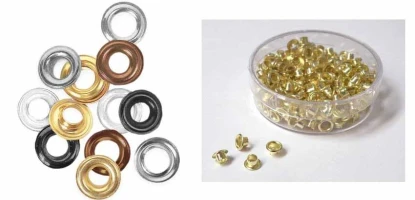
Compact Eyelet for Narrow Pleated Insect Screen Systems
This compact pleated insect screen eyelet is intended for cord, guide and connection points in narrow screen systems, narrow strips and applications where a larger eyelet would occupy too much installation space.
The 4.5 mm / 0.177 in inner opening provides a small passage for compatible cords, threads and connection components. The eyelet creates a controlled metal edge around the prepared hole and helps keep the passage point neat during screen movement.
The selected metal or plastic washer supports the rear side of the screen material. By increasing the contact area, the washer helps provide a firmer and more balanced hold and can reduce the risk of the screen pulling free from around the eyelet.
When Is This Eyelet a Suitable Choice?
- When a 4.5 mm / 0.177 in passage is required
- For narrow pleated insect screen systems
- For narrow screen strips and connection bands
- When larger eyelets occupy too much strip width
- For compatible cord, thread or guide openings
- When a metal or plastic rear washer is required
- When additional support is needed around a small opening
Size and Compatibility Information
| Product Type | Pleated insect screen eyelet |
|---|
| Inner Opening | 4.5 mm / 0.177 in |
|---|
| Washer Options | Metal washer or plastic washer |
|---|
| Recommended System | Narrow pleated insect screen systems |
|---|
| Recommended Strip | Narrow insect screen strips |
|---|
| Passage Use | Cord, thread, guide or connection opening |
|---|
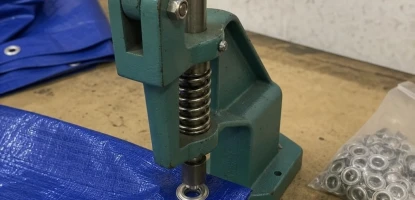
| Installation | Press setting with a compatible eyelet die |
|---|
Why Is It Suitable for Narrow Systems?
The compact 4.5 mm / 0.177 in opening requires less strip width than a larger eyelet. This makes it useful when the available installation area is limited or when the passage point must remain close to the size of the cord or guide component.
Compatibility must not be determined from the eyelet name alone. Screen-strip width, cord diameter, hole position and setting-die profile must be checked together.
Metal Washer or Plastic Washer?
Metal washer
A metal washer may be selected when a firmer rear support and a conventional metal installation structure are preferred. It helps spread the setting pressure over a wider rear contact area.
Plastic washer
A plastic washer may be considered when a lighter and softer rear support is more suitable for the selected screen strip. Its suitability should be tested with the actual screen material.
Metal and plastic washers are separate product options. The product must not be presented as including both washer types together.
How Does the Washer Improve the Hold?
Without sufficient rear support, installation pressure may remain concentrated around the narrow edge of the eyelet. A washer increases the rear contact area and helps distribute the holding force across more of the screen material.
This can provide a firmer and more balanced hold and help prevent the screen strip from pulling or slipping away around the opening.
Pull resistance also depends on the screen construction, hole position, cord movement, die profile and press adjustment.
Typical Applications
- Narrow pleated insect screen systems
- Narrow screen strips and connection bands
- Screen cord passage points
- Thread and guide openings
- Small screen connection points
- Pleated insect screen production
- Screen repair and component replacement
- Special narrow-system applications
Compatible Installation Tools
A setting die designed for eyelets with an inner diameter of approximately 4.5–5 mm / 0.177–0.197 in may be considered. The actual eyelet, washer and screen strip must be tested together before repeated production.
A separate punching die may be used to prepare the opening. A punching die prepares the material only; a compatible setting die is still required to close the eyelet over the washer.
Installation Steps
- Mark the installation point on the screen strip.
- Check that the cord or connection component fits through the 4.5 mm / 0.177 in opening.
- Confirm that the opening is not positioned too close to the strip edge.
- Prepare a clean and controlled hole with a compatible punching tool.
- Insert the eyelet from the front side of the screen material.
- Place the selected metal or plastic washer on the rear side.
- Centre the eyelet and washer inside the setting die.
- Apply press force gradually, beginning with a low setting.
- Check that the washer is held evenly around the eyelet.
- Perform a pull and slip test before repeated production.
Test with the Actual Screen StripStrip width, screen construction, hole position, washer type, setting-die profile and press force affect the finished installation. Always prepare a sample before production.
Selection and Installation Warnings
- Check the 4.5 mm / 0.177 in opening rather than selecting by appearance alone.
- Confirm that the cord or guide component fits through the opening.
- Do not position the eyelet too close to the strip edge.
- Do not prepare an oversized or irregular hole.
- Keep the eyelet and washer centred inside the setting die.
- Do not apply excessive press force to a thin screen strip.
- Do not assume compatibility with every pleated insect screen system.
- Do not assume that metal and plastic washers are supplied together.
Product Option
Select either a metal washer or plastic washer according to the screen construction and installation requirement.
The setting die, punching die, press and other installation equipment are not included.
Frequently Asked Questions
Which pleated screen systems is this eyelet intended for?
It may be considered for narrow pleated insect screen systems and narrow strips requiring a 4.5 mm / 0.177 in passage.
What is the inner opening?
The inner opening is 4.5 mm / 0.177 in.
Can I select a metal or plastic washer?
Yes. A metal washer or plastic washer may be selected as separate product options.
Does the washer provide a firmer hold?
The washer increases the rear contact area and helps the eyelet hold the screen material more firmly and evenly.
Does the eyelet prevent the screen from pulling away?
Correct hole preparation, washer selection, setting-die compatibility and press adjustment can help reduce the risk of the screen pulling away around the eyelet.
Is it compatible with every pleated insect screen system?
No. Strip width, cord diameter, hole position and system construction must be checked before installation.
Which setting die should be used?
A setting die for approximately 4.5–5 mm / 0.177–0.197 in inner-diameter eyelets may be considered after a sample compatibility test.
Is installation equipment included?
No. The setting die, punching die and press are purchased separately.
Content last updated: July 24, 2026 — E-Buttons

.webp-630x630.webp "Pleated Insect Screen Eyelet 4.5 mm / 0.177 in with Metal or Plastic Washer Options")
.webp-630x630.webp "Pleated Insect Screen Eyelet 4.5 mm / 0.177 in with Metal or Plastic Washer Options")
.webp-630x630.webp "Pleated Insect Screen Eyelet 4.5 mm / 0.177 in with Metal or Plastic Washer Options")
.webp-630x630.webp "Pleated Insect Screen Eyelet 4.5 mm / 0.177 in with Metal or Plastic Washer Options")
.webp-630x630.webp "Pleated Insect Screen Eyelet 4.5 mm / 0.177 in with Metal or Plastic Washer Options")
.webp-630x630.webp "Pleated Insect Screen Eyelet 4.5 mm / 0.177 in with Metal or Plastic Washer Options")
.webp-630x630.webp "Pleated Insect Screen Eyelet 4.5 mm / 0.177 in with Metal or Plastic Washer Options")
.webp-630x630.webp "Pleated Insect Screen Eyelet 4.5 mm / 0.177 in with Metal or Plastic Washer Options")
.webp-630x630.webp "Pleated Insect Screen Eyelet 4.5 mm / 0.177 in with Metal or Plastic Washer Options")
.webp-630x630.webp "Pleated Insect Screen Eyelet 4.5 mm / 0.177 in with Metal or Plastic Washer Options")
.webp-80x80.webp "Pleated Insect Screen Eyelet 4.5 mm / 0.177 in with Metal or Plastic Washer Options")
.webp-80x80.webp "Pleated Insect Screen Eyelet 4.5 mm / 0.177 in with Metal or Plastic Washer Options")
.webp-80x80.webp "Pleated Insect Screen Eyelet 4.5 mm / 0.177 in with Metal or Plastic Washer Options")
.webp-80x80.webp "Pleated Insect Screen Eyelet 4.5 mm / 0.177 in with Metal or Plastic Washer Options")
.webp-80x80.webp "Pleated Insect Screen Eyelet 4.5 mm / 0.177 in with Metal or Plastic Washer Options")
.webp-80x80.webp "Pleated Insect Screen Eyelet 4.5 mm / 0.177 in with Metal or Plastic Washer Options")
.webp-80x80.webp "Pleated Insect Screen Eyelet 4.5 mm / 0.177 in with Metal or Plastic Washer Options")
.webp-80x80.webp "Pleated Insect Screen Eyelet 4.5 mm / 0.177 in with Metal or Plastic Washer Options")
.webp-80x80.webp "Pleated Insect Screen Eyelet 4.5 mm / 0.177 in with Metal or Plastic Washer Options")
.webp-80x80.webp "Pleated Insect Screen Eyelet 4.5 mm / 0.177 in with Metal or Plastic Washer Options")
.webp-230x230.webp "4.5–5 mm / 0.18–0.20 in Eyelet Setting Die KLP0002")
.webp-230x230.webp "4.5 mm / 0.18 in Sheet Steel Long-Barrel Domed Eyelet – 250-Piece Pack K0003U")
-erb0002pru-(1).jpg-230x230.webp "4.5 mm / 0.18 in Brass Long-Barrel Eyelet – 500-Piece Pack ERB0002PRU")
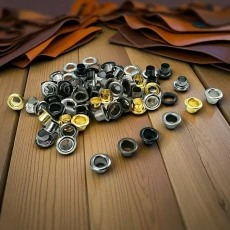
.webp-230x230.webp "4.5 mm / 0.18 in Silver (Nickel) Stainless Domed Eyelet – 1000-Piece Pack ER0002PPK")
.webp-230x230.webp "4.5 mm / 0.18 in Eyelet Punching Die KLP00020DEL")
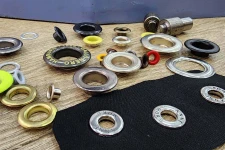


-no5-k0010%20(3).jpg-400x250h.webp "Iron Eyelets")

.jpg-415x200w.webp "Textile Accessories Material Guide: Brass, Stainless Steel, and Mild Steel")