.jpg-40x40.webp "Magnetic Snaps Buttons")

.jpg-40x40.webp "Prong Snap Fasteners for Baby Clothes")


.jpg-40x40.webp "Curved Snaps Buttons")


.jpg-40x40.webp "Snap Fasteners Half Dome type")
-no5-k0010%20(3).jpg-40x40.webp "Eyetlets")


-K0014.png-40x40.webp "Steel Eyelets and Iron Metal Grommets")

.jpg-40x40.webp "Flat Brass Eyelets and Grommets")

.jpg-40x40.webp "Aluminum Eyelets and Grommets")


.jpg-40x40.webp "Galvanized Eyelets and Grommets")


.jpg-40x40.webp "Grommet Punching Dies")
.jpg-40x40.webp "Hole Cutter Tools and Punching Dies")


.jpg-40x40.webp "Pearls Types")


.jpg-40x40.webp "Rivets")


.jpg-40x40.webp "Water-Repellent Jacket Zippers")


.jpg-40x40.webp "Tires")

.jpg-40x40.webp "Round Braided Elastic Cord")


.png-40x40.webp "Enameled Buttons")


.png-40x40.webp "Two Hole Sewing Buttons")


.jpg-40x40.webp "Carabiner Clips, Snap Hooks and Bag Hooks")


-PhotoRoom.png-40x40.webp "Spring Rings, Key Rings and Snap Clamps")


.png-40x40.webp "Hook and Eye Closures Sew-On")



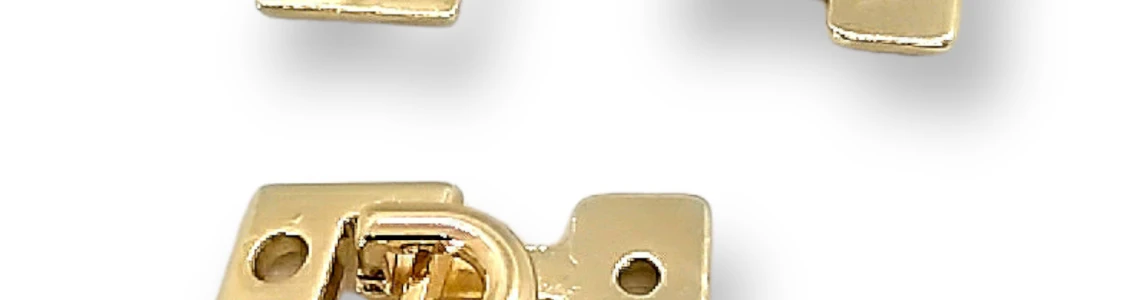
Buying hook-and-eye fasteners for garment production? A garment hook is not specified by appearance alone. An approved closure must fit the fabric stack, available sewing area, mating eye or loop, and finished garment's direction of pull. This E-Buttons guide is designed for apparel developers, trim buyers and production teams who need to compare components, approve samples and reorder the same part without ambiguity.
What is a hook-and-eye closure?
A hook-and-eye closure uses a shaped hook that engages a corresponding eye or receiving component. Sew-on metal versions can fasten clothing panels with little external hardware showing. Decorative frog fastenings and hook-and-bar waistband closures may also appear under broadly similar retail categories, although their structures and assembly requirements differ.
Choose hardware according to the sewing application
Low-profile closures on dresses and tailored garments
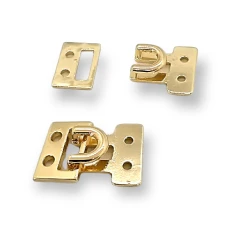
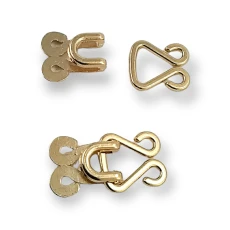
For a concealed connection, check how the hook projects from the fabric, whether the edge is reinforced, and how the mating component sits after the garment is closed. A narrow visible part does not automatically mean that the sewing footprint is small enough. The E 1858 metal garment hook illustrates a compact metal hook form. Confirm the sewing dimensions for your intended assembly.
Jacket, outerwear and fashion closures
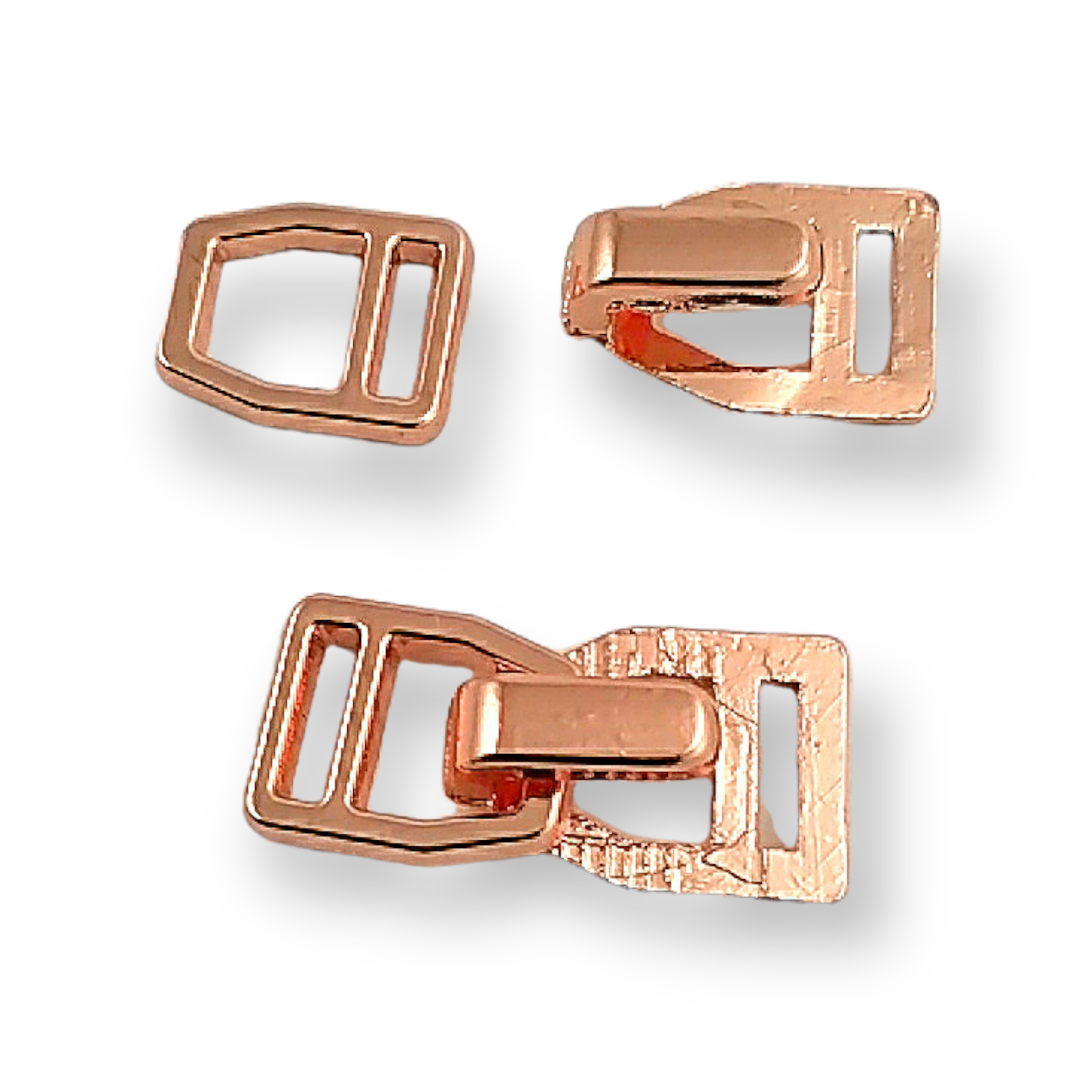
Outerwear trims often need more room around stitching and seams. Some decorative clasps are chosen to be visible, while a plain sew-on hook is designed to blend into the finished garment. Select on the basis of fabric thickness, placement and the resulting silhouette, not only the nominal size or plating color.
Check the complete assembly: E 1763 and E 1762
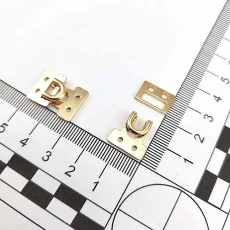
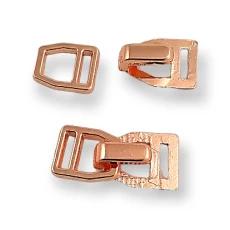
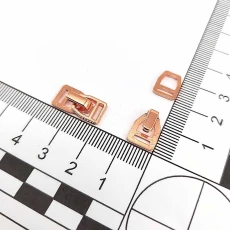
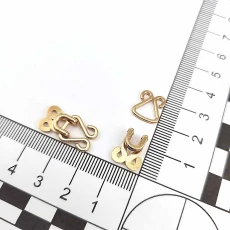
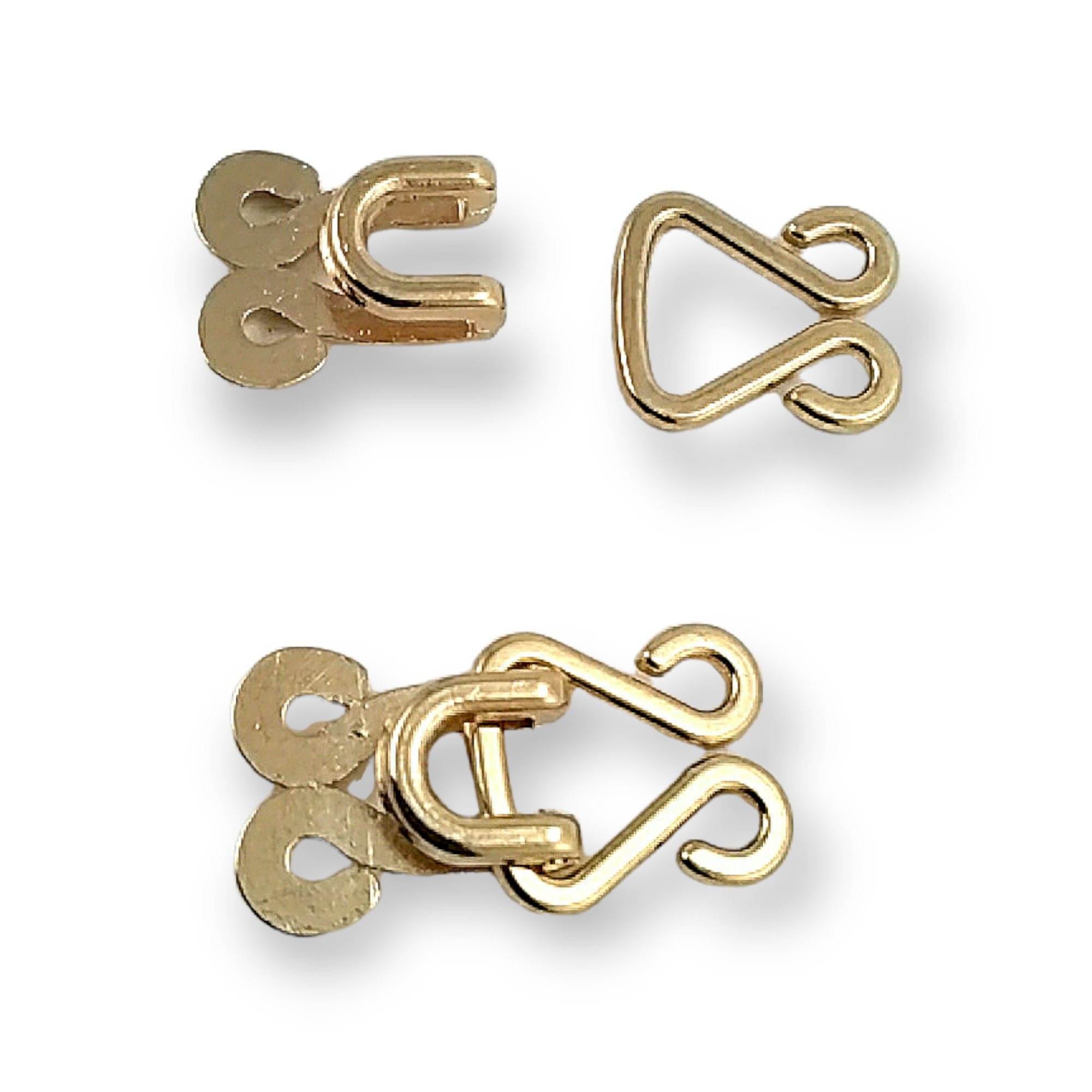
The live E-Buttons listing for E 1763, 14.5 mm / approximately 0.57 in sew-on garment hook specifies a 14.5 mm sewing width. It also describes a 21 mm overall length and 4.4 mm hook height. Treat those as separate dimensions rather than interchangeable descriptions of a single measurement. The E 1762 is cataloged as a 7.5 mm (approximately 0.30 in) zinc-alloy hook, with a different shape and fitting space; do not mix its components with E 1763 without mechanical validation.
Quick sourcing reference: dimensions and approval
| Catalog code | Published identification | What to confirm |
|---|---|---|
| E 1858 | Small metal hook; confirm dimensions against the chosen model | Request confirmed drawing before specifying dimensions |
| E 1762 | 7.5 mm / approx. 0.30 in zinc-alloy hook option | Hook profile, receiver, sewing width and finish |
| E 1763 | 14.5 mm / approx. 0.57 in sewing width | 21 mm / approx. 0.83 in overall length; 4.4 mm / approx. 0.17 in hook height; mating part |
Fasteners with similar nominal sizes are not necessarily interchangeable. “Width” may mean the stitchable section rather than the visible external envelope. Keep a drawing, mating-component sample or verified part number with the purchase order.
Production sample approval: six practical steps
- Identify material. Record fabric type, layer stack, reinforcement and seam allowance at the fastening location.
- Check orientation. Determine the garment overlap and intended opening direction before placing either part.
- Match the receiver. Confirm the hook engages the exact counterpart supplied or approved for the job.
- Record measurements. Separate sewing footprint, outside length and hook projection in the trim specification.
- Test a garment sample. Inspect repeated engagement, ease of release and fabric distortion around the attachment.
- Control repeat orders. Retain the approved code, color finish, sample image and mating-component reference.
When should buyers select a hook-and-bar instead?
Trouser and skirt waistband closures may use dedicated hook-and-bar assemblies, sometimes alongside a zipper. These are not simply decorative sew-on hooks with a different trade name. Compare the attachment method and available tooling for the garment construction. For visible outerwear closures, ornament and profile become more important, but fit approval remains essential.
Review the E-Buttons collection
Use the E-Buttons sew-on hook-and-eye closure category as the starting point for model comparison. For an example with published installation dimensions, open E 1763 hook-and-eye garment fastener. Confirm current size options, finish, availability and quantities on each live product listing before issuing a purchase order.
Frequently asked questions for apparel buyers
Are frog fastenings suitable for concealed garment seams?
Some are decorative and intended to show. Selection depends on the specific design, assembly and fabric placement.
Does a 14.5 mm specification mean outside width?
Not by default. The E 1763 listing identifies 14.5 mm as sewing width; the overall length and hook height are separate measurements.
Can similarly sized garment hooks share the same eye?
Not unless the corresponding part geometry has been confirmed by the supplier or in a physical fitting test.
What should be included in a purchase specification?
Exact model code, complete matching components, attachment method, verified dimensions, plating or finish and approved production sample.
Why approve the hook on the finished fabric?
The fabric stack and seam geometry influence access, ease of use, appearance and durability of the attachment.