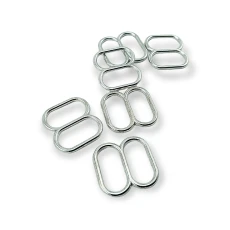
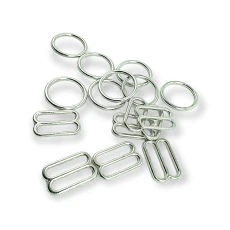
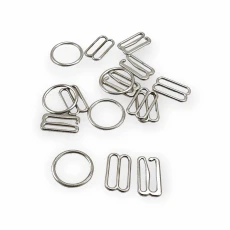
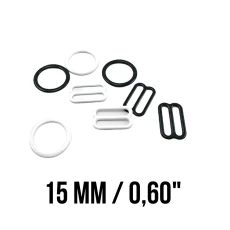
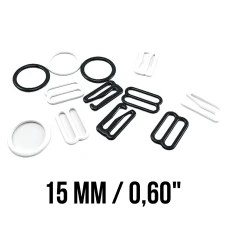
15 mm / 0.59 in Zamak Bra Strap Slider and Ring 2-Piece Set combines one slider and one ring in a 15 mm / 0.59 in Zamak lingerie-hardware set. The hook is not included. Final approval should use the actual production strap and approved garment construction.
What the 2-piece set includes
15 mm / 0.59 in Zamak Bra Strap Slider and Ring 2-Piece Set combines one bra strap slider and one ring in a single sales unit. The slider adjusts usable strap length, while the ring creates a connection or direction-change point. The hook is not included. On e-buttons, the set should be approved with the actual production tape because thickness, elasticity, fold construction and stitch placement can affect the two components differently.
Metric and imperial sizing
The English listing keeps the original 15 mm metric reference and adds 0.59 in for US purchasing teams. Both values describe the same nominal family. Two tapes sold under that width can still differ in finished width, edge firmness, thickness and stretch. The size narrows the catalog, but physical approval should use the actual production tape because the slider and ring can respond differently to textile construction.
Zamak material
Both components are classified as Zamak. The material field answers a different sourcing question from size or component function. No unsupported claim is made about coating thickness, corrosion resistance, saltwater performance or wash endurance. If a project requires a defined finish standard, that requirement should be confirmed separately before production rather than inferred from the base material.
How the slider and ring work together
The slider controls usable strap length, while the ring provides a connection or direction-change point. The two components should be reviewed on the same completed sample because tape thickness and fold construction can influence them differently. A slider may move correctly on its own while the ring sits at an unexpected angle after stitching. The completed strap is therefore the best approval reference.
Bras and bralettes
Bra and bralette straps often use a slider-and-ring combination when the design calls for both adjustment and a connection point. Not every garment uses the same construction, so nominal size alone is not enough. Review adjustment range, ring angle, fold allowance and seam position on the approved sample. Recording the construction helps production reproduce the same relationship during repeat manufacturing.
Swimwear and bikini straps
Swimwear elastic can narrow, stretch or change angle under load. This can affect slider movement and ring orientation at the same time. Review the sample relaxed and under light tension that resembles actual use. This is a practical production-fit check, not a claim about corrosion, saltwater or coating durability.
Why the hook is not included
This is a 2-piece set containing a slider and ring only. If the garment also requires a hook, it should be sourced separately or the 3-piece set should be considered. When a hook is not used, the 2-piece set can avoid holding an unnecessary third component in inventory. The purchasing format should follow the actual bill of materials rather than a preference for the largest set.
Single components versus the set
A set can simplify warehouse picking when one slider and one ring are always consumed together. If the two components are used at different rates across styles, single-component inventory can offer more flexibility. The correct format depends on real production consumption. Buyers should compare unit count, physical piece count and the garment bill of materials before deciding between single items and the set.
Compare the hardware family
Use the Bra Rings, Hooks and Strap Adjustment Buckles category to compare single sliders, rings, hooks and the 3-piece set in the same family. Start with component function, then narrow by 15 mm / 0.59 in size and Zamak material. This reduces the chance of choosing the right nominal width but the wrong buying format.
Sample both components with the real tape
Use the actual production tape and build the complete strap section. Confirm that the slider moves through the intended adjustment range and that the ring sits at the approved connection angle. Look for binding, bunching, excess play or unexpected rotation. Reviewing both pieces together reveals interaction that cannot be judged by measuring each metal component separately.
Fold allowance and stitch placement
Tape is often folded and stitched close to both the slider and ring. Folded layers create more thickness than one flat layer. A seam too close to the slider can restrict adjustment, while a seam too close to the ring can pull the connection off-angle. Record approved fold allowances and stitch distances on the technical sheet so production can reproduce the same construction.
When the tape supplier changes
A new supplier or production lot can change thickness, stretch, edge firmness or surface friction without changing the nominal 15 mm / 0.59 in label. Previous approval should not automatically be treated as valid. Make a short verification sample and compare slider movement, ring angle and seam relationship before releasing the full quantity. This can detect compatibility changes early and reduce rework.
First-run production verification
After sample approval, compare the first completed production straps with the reference. Slider orientation, ring position, tape path, stitch distance and visual proportion should remain consistent. If the first units sit differently, review the tape lot and assembly method before the entire order is completed. The complete strap system is a more useful troubleshooting reference than either metal part alone.
Technical sheet and bill of materials
The technical sheet should record 2-Piece Bra Strap Slider and Ring Set, the 15 mm / 0.59 in size family, Zamak material and the physical contents of one sales unit. It should be clear that one set equals one slider plus one ring. The approved strap tape should also have a stock or sourcing reference where possible.
Warehouse separation and counting
A 2-piece set is one sales unit but represents two physical components. Warehouse labels should show set type, 15 mm / 0.59 in size and Zamak material. Single sliders and rings should remain separate inventory records. During counting, 500 sets represent 500 sliders and 500 rings, or 1,000 physical components in total.
Package content and minimum order
One sales unit contains one bra strap slider and one ring. The minimum order is 500 sets. Package content and MOQ describe different things: package content states what is included in one set, while MOQ defines how many sets can be ordered. Production planning should convert set quantity into physical component requirements when comparing inventory or consumption.
Production quantity planning
Total demand depends on how many sets are used in each finished garment. A style using two adjustable straps may consume more than a design using one set. Requirements can be consolidated when several sizes or colorways use the same approved set. Different sizes, materials or set structures should remain separate inventory items so reorder points reflect real physical demand.
Signs that selection should be reviewed
Binding at the slider, unstable ring angle, bunching, excessive play or an unbalanced finished strap can indicate that the set-tape relationship should be reviewed. These symptoms do not automatically mean either metal part is defective. Tape thickness, elasticity, folded construction and stitch position can create similar effects. Compare the production piece with the approved sample before making substitutions.
Quality-control points
Quality control should review both components together. Check slider movement, ring angle, tape direction, seam location and final visual balance against the approved sample. If behavior changes later in production, compare tape lot and assembly method before assuming that the hardware has changed. This system-level review makes corrective action more closely tied to the real cause.
Repeat-order discipline
Repeat orders should not rely on a generic phrase such as 15 mm set. Carry 2-Piece Bra Strap Slider and Ring Set, 15 mm / 0.59 in size, Zamak material and package content consistently across purchase orders, warehouse labels and technical sheets. Clear naming helps later production teams identify the same approved set and reduces confusion with single components or the 3-piece set.
Care and finish boundaries
The final care behavior of hardware depends on more than the base material. Finish, garment dye, cleaning chemistry and surrounding textiles can all influence the result. Because no specific coating-performance or corrosion-test value is stated here, the page does not make a blanket durability claim. Final garment care instructions should be established for the complete product and special requirements validated under intended conditions.
Archive the approved sample
Keeping an approved physical strap sample or clear reference image after production helps future repeat orders. When the style returns, teams can compare the current slider-ring arrangement, tape routing and seam relationship with the previous reference instead of relying only on an old purchase name. This is especially useful when single parts and several set formats share the same nominal size.
Final pre-purchase review
Before ordering, confirm 2-Piece Bra Strap Slider and Ring Set, 15 mm / 0.59 in size, Zamak material, one-slider-plus-one-ring package content and the 500-set minimum order. Sample the actual production tape and verify whether a hook is also required. Keep the same product description on the purchase order, technical sheet and warehouse record.
Frequently Asked Questions
What is included in one set?
1 bra strap slider and 1 ring.
Is a hook included?
No.
What is the material?
Zamak.
What is the size?
15 mm / 0.59 in.
What is the minimum order?
500 sets.
Should the set be sample-tested?
Yes, with the actual production strap.

.jpg-40x40.webp "Magnetic Snaps Buttons")

.jpg-40x40.webp "Prong Snap Fasteners for Baby Clothes")


.jpg-40x40.webp "Curved Snaps Buttons")


.jpg-40x40.webp "Snap Fasteners Half Dome type")
-no5-k0010%20(3).jpg-40x40.webp "Eyetlets")


-K0014.png-40x40.webp "Steel Eyelets and Iron Metal Grommets")

.jpg-40x40.webp "Flat Brass Eyelets and Grommets")

.jpg-40x40.webp "Aluminum Eyelets and Grommets")


.jpg-40x40.webp "Galvanized Eyelets and Grommets")


.jpg-40x40.webp "Hole Cutter Tools and Punching Dies")

.jpg-40x40.webp "Grommet Punching Dies")


.jpg-40x40.webp "Pearls Types")


.jpg-40x40.webp "Rivets")


.jpg-40x40.webp "Water-Repellent Jacket Zippers")


.jpg-40x40.webp "Tires")

.jpg-40x40.webp "Round Braided Elastic Cord")


.png-40x40.webp "Enameled Buttons")


.jpg-40x40.webp "Carabiner Clips, Snap Hooks and Bag Hooks")


-PhotoRoom.png-40x40.webp "Spring Rings, Key Rings and Snap Clamps")


.png-40x40.webp "Hook and Eye Closures Sew-On")


.webp-630x630.webp "15 mm / 0.59 in Zamak Bra Strap Slider and Ring 2-Piece Set PIR700015Z")
.webp-630x630.webp "15 mm / 0.59 in Zamak Bra Strap Slider and Ring 2-Piece Set PIR700015Z")
.webp-630x630.webp "15 mm / 0.59 in Zamak Bra Strap Slider and Ring 2-Piece Set PIR700015Z")
.webp-630x630.webp "15 mm / 0.59 in Zamak Bra Strap Slider and Ring 2-Piece Set PIR700015Z")
.webp-630x630.webp "15 mm / 0.59 in Zamak Bra Strap Slider and Ring 2-Piece Set PIR700015Z")
.webp-630x630.webp "15 mm / 0.59 in Zamak Bra Strap Slider and Ring 2-Piece Set PIR700015Z")
.webp-630x630.webp "15 mm / 0.59 in Zamak Bra Strap Slider and Ring 2-Piece Set PIR700015Z")
.webp-630x630.webp "15 mm / 0.59 in Zamak Bra Strap Slider and Ring 2-Piece Set PIR700015Z")
.webp-630x630.webp "15 mm / 0.59 in Zamak Bra Strap Slider and Ring 2-Piece Set PIR700015Z")
.webp-630x630.webp "15 mm / 0.59 in Zamak Bra Strap Slider and Ring 2-Piece Set PIR700015Z")
.webp-80x80.webp "15 mm / 0.59 in Zamak Bra Strap Slider and Ring 2-Piece Set PIR700015Z")
.webp-80x80.webp "15 mm / 0.59 in Zamak Bra Strap Slider and Ring 2-Piece Set PIR700015Z")
.webp-80x80.webp "15 mm / 0.59 in Zamak Bra Strap Slider and Ring 2-Piece Set PIR700015Z")
.webp-80x80.webp "15 mm / 0.59 in Zamak Bra Strap Slider and Ring 2-Piece Set PIR700015Z")
.webp-80x80.webp "15 mm / 0.59 in Zamak Bra Strap Slider and Ring 2-Piece Set PIR700015Z")
.webp-80x80.webp "15 mm / 0.59 in Zamak Bra Strap Slider and Ring 2-Piece Set PIR700015Z")
.webp-80x80.webp "15 mm / 0.59 in Zamak Bra Strap Slider and Ring 2-Piece Set PIR700015Z")
.webp-80x80.webp "15 mm / 0.59 in Zamak Bra Strap Slider and Ring 2-Piece Set PIR700015Z")
.webp-80x80.webp "15 mm / 0.59 in Zamak Bra Strap Slider and Ring 2-Piece Set PIR700015Z")
.webp-80x80.webp "15 mm / 0.59 in Zamak Bra Strap Slider and Ring 2-Piece Set PIR700015Z")
.webp-230x230.webp "11 mm / 0.43 in Zamak Bra Strap Hook PIR750011Z")
.webp-230x230.webp "11 mm / 0.43 in Zamak Bra Strap Ring PIR720011Z")
.webp-230x230.webp "11 mm / 0.43 in Zamak Bra Strap Slider and Ring 2-Piece Set PIR700011Z")
.webp-230x230.webp "11 mm / 0.43 in Zamak Bra Strap Slider PIR710011Z")
.webp-230x230w.webp "11 mm / 0.43 in Zamak Bra Strap Slider, Ring and Hook 3-Piece Set PIR770011Z")
.webp-230x230.webp "15 mm / 0.59 in Zamak Bra Strap Hook PIR750015Z")