
-
Store Collections
-
Zippers
-
Snap Buttons
- Magnetic Snaps Buttons0
- Coin Type Snap Fasteners0
- Prong Snap Fasteners for Baby Clothes0
- Plastic Snap Fasteners0
- Brass Snap Fasteners0
- Wallet Snaps Buttons - VT2 Snaps Buttons0
- Curved Snaps Buttons0
- Stainless Snap Fasteners0
- Deluxe Series Snap Buttons0
- Coat Snap Buttons0
- Sew-On Snap Fasteners0
- Snap Fasteners - Iron Metal0
- Zinc Alloy Snap Fasteners0
- Hidden Snap Fasteners0
- Snap Fasteners Half Dome type0
-
Eyelets
- Stainless Steel Eyelets0
- Brass Eyelets0
- Domed Brass Eyelets and Grommets0
- Oval Eyelets and Grommets0
- Pleated Fly Screen and Pleated Blind Eyelets0
- Steel Eyelets and Iron Metal Grommets0
- Plastic Eyelets and Grommets0
- Flat Brass Eyelets and Grommets0
- Double-Sided Eyelets0
- Aluminum Eyelets and Grommets0
- Zamak Zinc Alloy Eyelets and Grommets0
- Coin Type Eyelets0
- Contoured Brass Eyelets and Grommets0
- Long Barrel Eyelets and Grommets0
- Mesh Eyelets and Ventilation Grommets0
- Short Barrel Eyelets and Grommets0
- Galvanized Eyelets and Grommets0
- Narrow-Edged Eyelets0
-
Tools - Dies and Molds
- Grommet Dies & Setting Tools0
- Snap Fasteners Installation Tools and Dies0
- Setting Tools and Machines0
- Grommet Punching Dies0
- Hole Cutter Tools and Punching Dies0
- Rivet Assembly Tools0
- Fabric Covered Button Tools0
- Pearl Mounting Accessories0
- Jeans Button Assembly Tools0
- Trouser and Skirt Hook and Bar Assembly Patterns0
- Sewing Buttons
-
Buckles
- Carabiner Clips, Snap Hooks and Bag Hooks0
- D Rings, O Rings and Strap Adjustment Buckles0
- Pin Buckles, Center Bar Buckles, Belt and Bag Strap Buckles0
- Locking Rings and Openable Metal Rings0
- Spring Rings, Key Rings and Snap Clamps0
- Side Release Buckles and Slide Adjusters0
- Coat, Jacket and Garment Hanger Chains0
- Hook and Bar Closure Clasp No Sew0
- Hook and Eye Closures Sew-On0
- All Products
Lingerie Accessories and Bra Buckles
Lingerie Accessories and Bra Buckles is structured to help compare the 38 listed product records by size, construction, and buying intent. Dimensions and material wording visible in product names are starting points; technical compatibility should be confirmed on each live E-Buttons page and with a production sample.
Key selection axes: 10 mm, 12 mm, 13 mm, 16 mm, 8 mm, 2.5 cm, 2 cm, 16mm; Plastic, Metal, Brass, Zinc alloy, Iron; correct mating component and installation method.
Build a production-ready trim selection: Explore bra rings, hooks and strap sliders. Use the E-Buttons bra clasp and sourcing guide to distinguish adjustment parts from true closures.
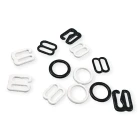
Shop Bra Strap Sliders, Rings, Hooks and Lingerie Hardware
Building or repairing a bra strap assembly requires more than choosing hardware that looks similar. Strap adjusters control length, rings connect sections of elastic, hooks provide specified fastening points, and matching sets can simplify component selection. E-Buttons carries lingerie and swimwear hardware for garment makers, sample rooms and small-batch production. Start with the actual elastic width and thickness, then check the usable opening, finish, connection geometry and package contents on each product page.
Choose the Correct Type of Bra Hardware
Bra Strap Sliders and Adjusters
A slider allows the wearer to change strap length. Check the tape passage and the threading path rather than assuming the outer dimensions equal the strap size. The PBT0001 adjuster is listed for 16 mm (0.63 in) tape, with an external size of 19 × 16.5 mm (0.75 × 0.65 in).
Bra Rings and D-Rings
Rings connect a strap to the garment or another strap section. The internal opening and the angle at which the elastic travels through the ring both matter. A ring and slider sold under the same nominal size still need a practical fit test.
Bra Hooks and Clasps
Hooks may connect strap assemblies or other lingerie components. A strap hook is not automatically the same as a multi-row back closure. Check its mating part, fastening direction and whether the component is supplied separately or as a set.
Two-Piece and Three-Piece Sets
Sets can reduce the work of sourcing coordinated parts, but their contents differ by SKU. A three-piece design may contain a strap slider, ring and hook. The 12 mm (0.47 in) AK00120 set is one model to review; confirm the exact number of individual components and ordering unit before purchasing.
Garter Clips and Specialty Lingerie Closures
Garter clips are intended for a different connection task than bra strap adjusters. For garters and specialty lingerie, compare the clip mechanism, tape width and fabric engagement instead of substituting an ordinary slider.
Explore Verified Product Examples
Size Guide: Millimeters and Inches
Common nominal widths include 8 mm (0.31 in), 10 mm (0.39 in), 12 mm (0.47 in), 15 mm (0.59 in), 16 mm (0.63 in), and 20 mm (0.79 in). These numbers are useful starting points, not a guarantee of interchangeability. Compare the elastic width, its thickness, the actual hardware opening and the path of the strap. Confirm whether the published measurement describes usable tape width, an inner opening or the overall part.
Material, Finish and Production Considerations
Plastic, zinc alloy and coated metal components may be offered across different styles. Material and finish vary by model; do not infer wash resistance, saltwater suitability, nickel-free status or skin-contact certification without product-specific evidence. Test a sample on the intended garment, including the actual stitching and tension. For swimwear, assess the finish under the expected water and care conditions before production.
Before You Order
- Measure the finished elastic or tape, including thickness.
- Confirm whether you need a slider, ring, hook, garter clip or a coordinated set.
- Check the usable opening and the direction of the connection.
- Review each SKU's finish, color options, package contents and minimum quantity.
- Assemble a sample and test strap movement, slipping and fastening.
- Keep cup-support underwires separate from strap hardware when comparing specifications.
Frequently Asked Questions
What does a bra strap slider do?
It adjusts strap length by allowing elastic to be threaded through a movable fitting.
Is every 10 mm slider compatible with a 10 mm strap?
No. Tape thickness, the usable opening and the threading geometry must also fit.
What is usually included in a three-piece bra hardware set?
A model may combine a slider, ring and hook. Always check the specific SKU's contents and order unit.
Are bra hooks the same as back closures?
Not necessarily. Strap hooks and multi-row back closures serve different functions.
Can the same hardware be used for swimwear?
Only after checking the model's intended use, fit and finish performance under expected conditions.
How should I choose metal versus plastic hardware?
Consider garment design, contact surfaces, elastic fit and actual sample performance, not appearance alone.