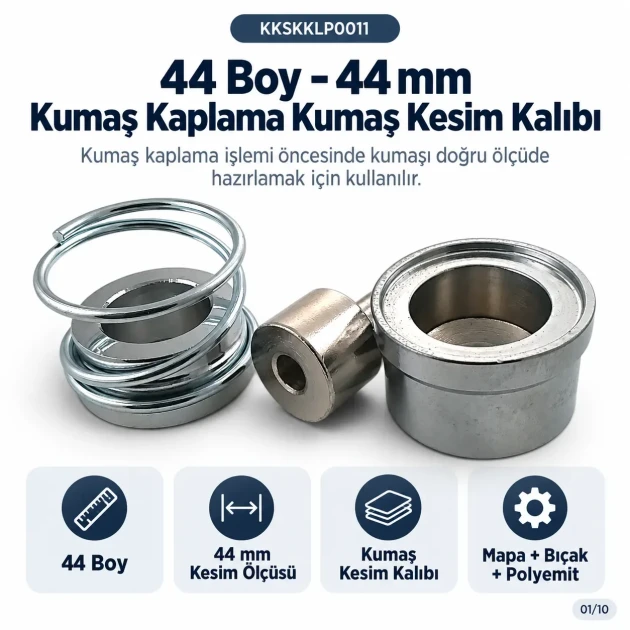
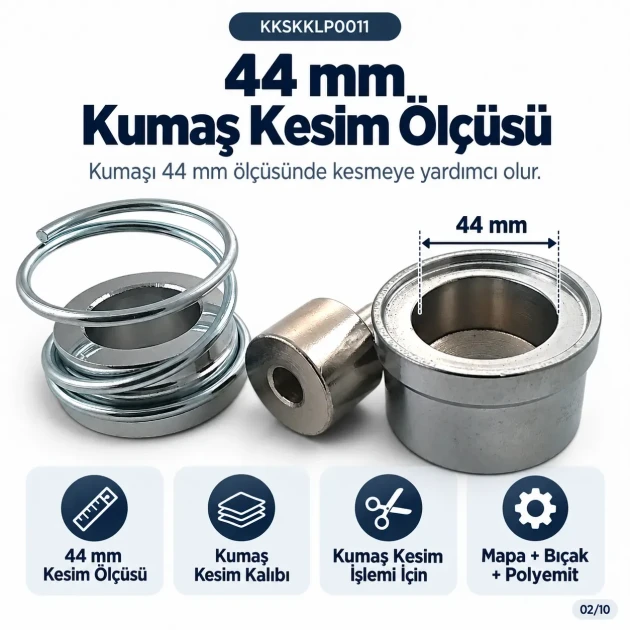
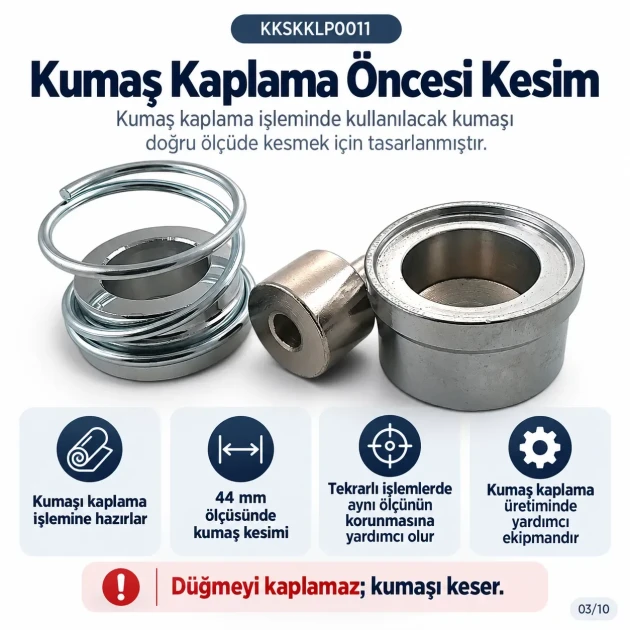
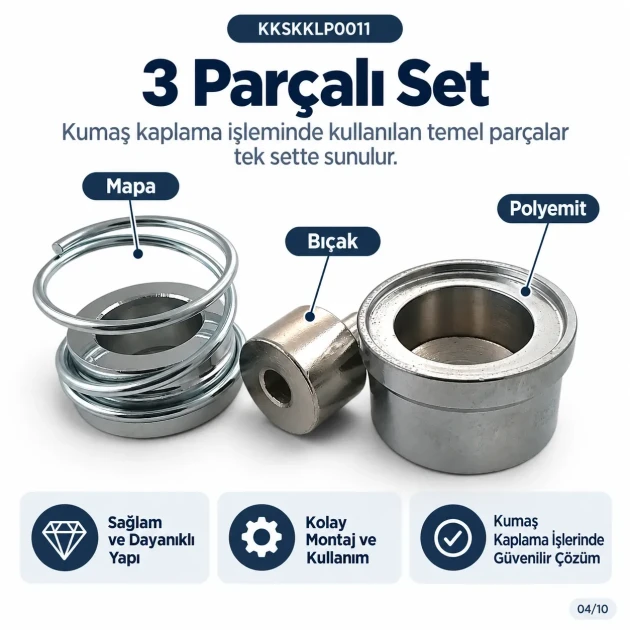
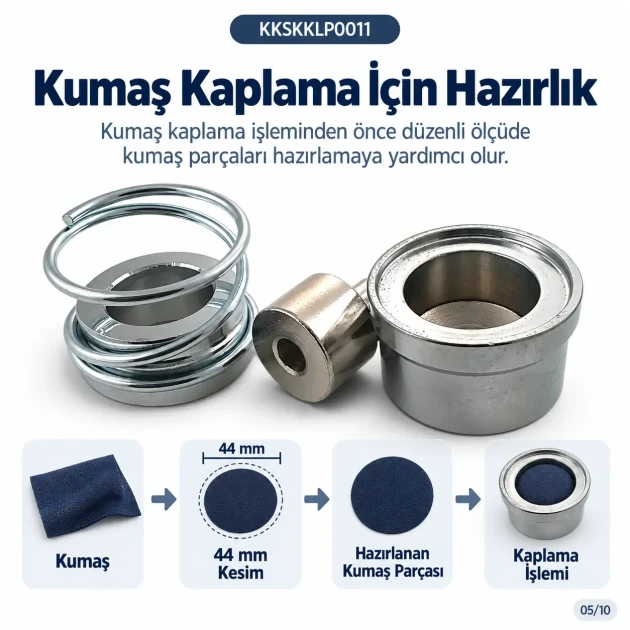
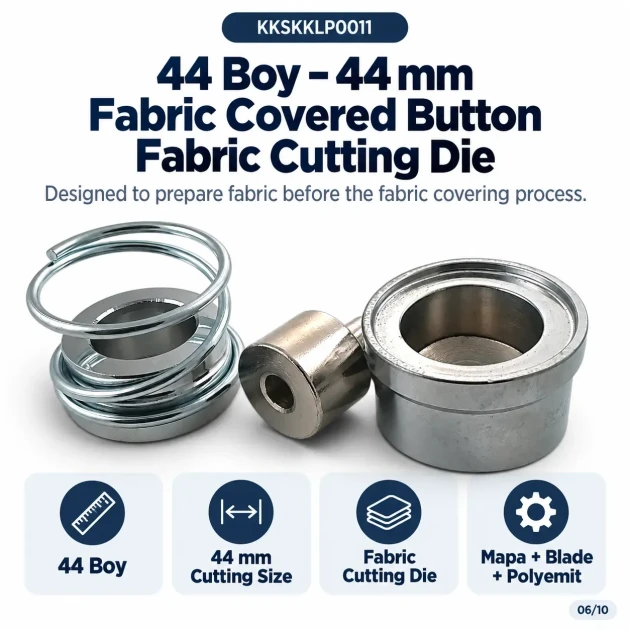
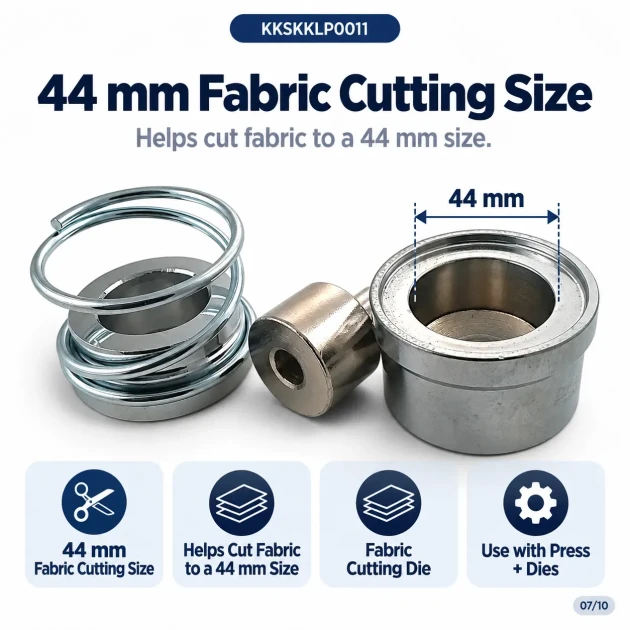
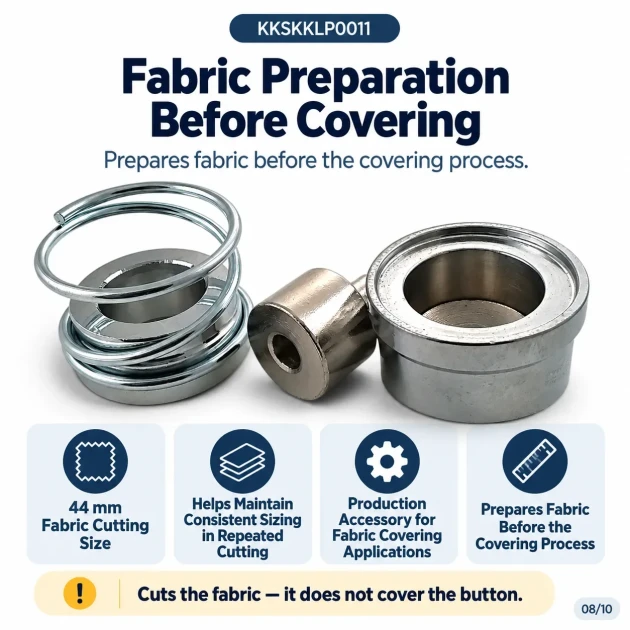
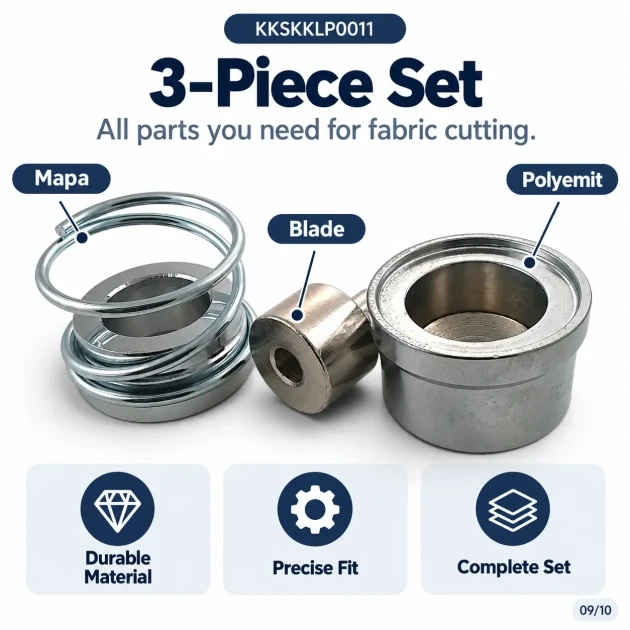
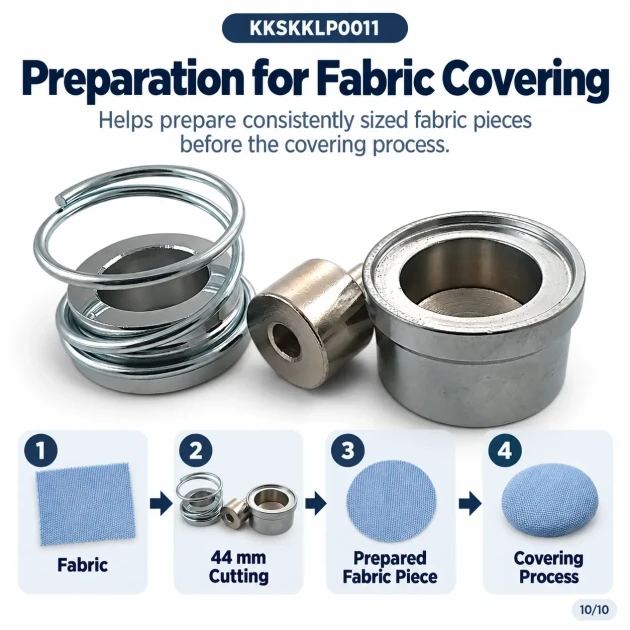
This 44L die is for 28 mm / 1.10 in fabric-covered shank buttons and is used after the fabric has already been prepared. It supports a controlled covering step by bringing the correct fabric circle and button shell together in the same size family. The die does not cut the textile. For this 44L setup, the fabric is prepared at 44 mm / 1.73 in before it moves into the covering stage.
When Should You Choose This 44L Covering Die?
Choose this tool when the job is to cover a 44L / 28 mm shank-style button with fabric. It is intended for the stage where the cut textile is positioned around the shell and checked for centering, edge gathering and overall appearance. It is not a substitute for the fabric-cutting step, and similar diameters in other product systems should not be assumed to be interchangeable.
Understand the 28 mm Finished Size and the 44 mm Fabric Cut
The 28 mm / 1.10 in measurement describes the finished button. The 44 mm / 1.73 in measurement describes the fabric circle prepared before covering. The textile needs extra diameter because it has to cross the visible face, wrap around the edge and gather behind the shell.
The natural companion for preparation is the 44 mm / 1.73 in fabric cutting die. Keeping preparation and covering as two separate steps makes the workflow easier to control and troubleshoot.
Fabric Behavior Matters as Much as Size
A lightweight woven material can gather very differently from a thick decorative textile. Stretch fabric may shift during positioning, slippery fabric can move away from the intended center, and layered materials can create extra bulk behind the shell. For this reason, always make a few samples with the actual production textile before preparing a full batch.
If backing, interfacing or a second textile layer will be used in the finished button, include that full construction in the sample. A single-layer test may not represent the final result.
Plan Pattern Placement Before the Fabric Is Cut
With stripes, checks, logos or directional prints, the visible center should be decided before the 44 mm circle is prepared. For a set of matching buttons, use the same visual reference across the batch. Brushed or shiny textiles can also change appearance when rotated, so surface direction should stay consistent.
Recommended Workshop Sequence
- Lay the actual production textile flat.
- Choose the visual center or surface direction if needed.
- Prepare the fabric at 44 mm / 1.73 in.
- Inspect the cut edge and overall circle shape.
- Set aside the first pieces as samples.
- Place the prepared textile and the 28 mm / 1.10 in shank-button shell into the covering die.
- Inspect the face, edge gathering and back side of the first finished button.
- Continue the batch only after the sample is approved.
Who Benefits from This Tool?
This die is useful for sample rooms, tailoring, boutique apparel production, costume work and other small- or medium-batch workflows where covered buttons need to match. Using the same textile on the button face can help jackets, dresses, vests and custom garments look more integrated. The tool does not create the design choice; it supports more repeatable execution of that choice.
Three Measurements to Check Before Ordering
Keep the complete size relationship together: 44L size class, 28 mm / 1.10 in finished button diameter and 44 mm / 1.73 in fabric cut. The finished diameter and preparation diameter describe different stages. Confusing them can lead to the wrong tool or an incorrect fabric allowance.
Use the fabric-covered button tools category to compare other size families and keep the cutting and covering tools matched correctly.
Technical Details
| Tool type | Fabric-covered shank button die |
| Size class | 44L |
| Finished button diameter | 28 mm / 1.10 in |
| Fabric preparation diameter | 44 mm / 1.73 in |
| Operation | Covers pre-cut fabric over the button shell |
| Fabric cutting | Separate operation |
| Button construction | Shank-style fabric-covered button |
| Weight | 390 g / 0.86 lb |
What Problems Can Incorrect Preparation Cause?
A fabric circle that is too small may not leave enough material to wrap the edge. One that is too large can create unnecessary bulk at the back. If the shell or die is from the wrong size family, the button may not seat correctly. Even with the correct dimensions, fabric thickness and stretch can change the result, which is why the first sample is an important production check.
Use the First Finished Button as the Approval Standard
Do not judge the setup only from the cut fabric circle. Complete one button and inspect it from the front and back. Check that the motif or weave direction is centered, that the fabric is not visibly distorted and that the back side does not contain unnecessary bulk. Once approved, keep that sample as a reference for the rest of the batch.
Quality Check Before the Full Batch
Use the first finished button as an approval sample. Look at the visible face for off-center fabric, distortion or uneven tension, then inspect the back for unnecessary bulk or irregular gathering. If the result is not consistent, review the fabric cut, textile thickness and placement before continuing. This prevents the same problem from being repeated across the entire batch.
When the Textile Changes
A different fabric deserves a new sample even when the 44L size stays the same. Heavier, stretchier, backed or more directional textiles can behave differently around the shell. Keep the verified 28 mm finished size and 44 mm preparation size relationship, but recheck how the new material gathers and centers.
Pre-Order Verification
Before ordering, confirm that your workflow requires a 44L / 28 mm / 1.10 in shank-style covered button and a 44 mm / 1.73 in prepared fabric circle. If either the finished size or the preparation diameter is different, choose the matching size family rather than trying to adapt the wrong tool.
Frequently Asked Questions
Does this die cut fabric?
No. The fabric must be cut separately before the covering stage.
What finished button size is this for?
44L / 28 mm / 1.10 in shank-style fabric-covered buttons.
What fabric cut should be used?
44 mm / 1.73 in for this size family.
Can patterned fabric be used?
Yes. Choose the visible center before cutting and preserve the orientation during covering.
Should thick fabric be tested first?
Yes. Thickness, backing and layer count can change the finished result.
Where can I compare other sizes?
Use the e-Buttons fabric-covered button tools category to compare other size families.