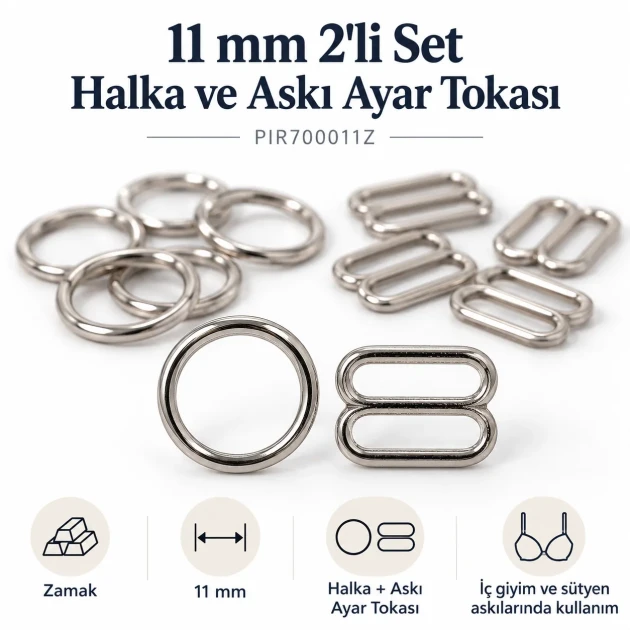
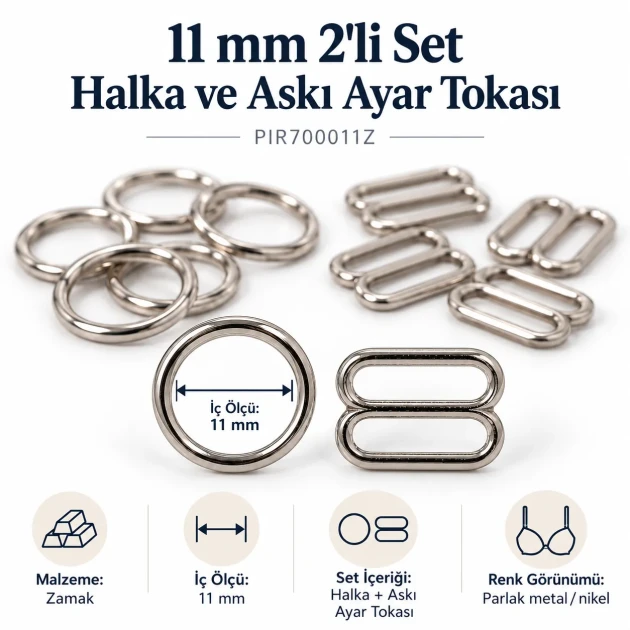
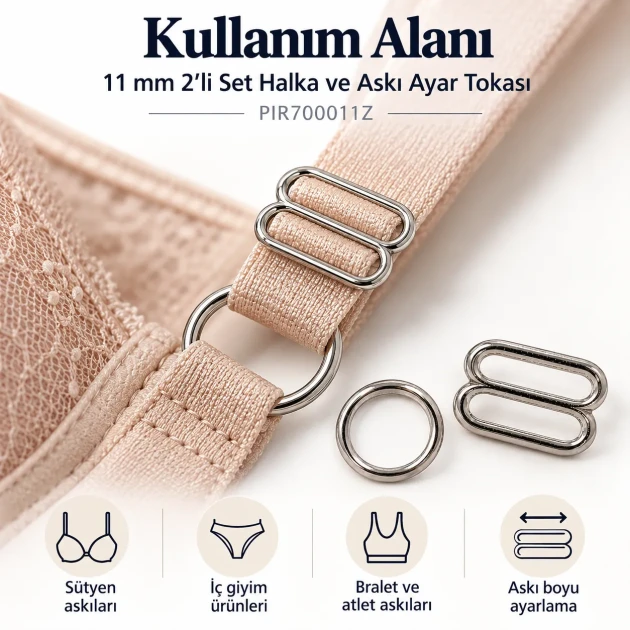
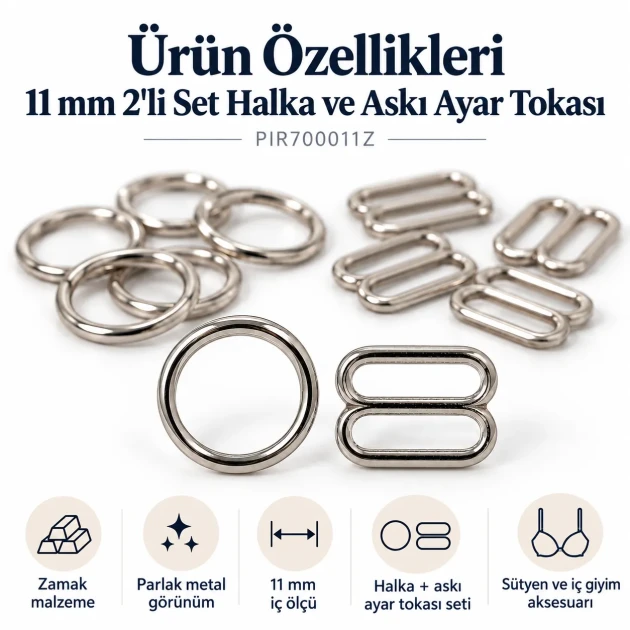
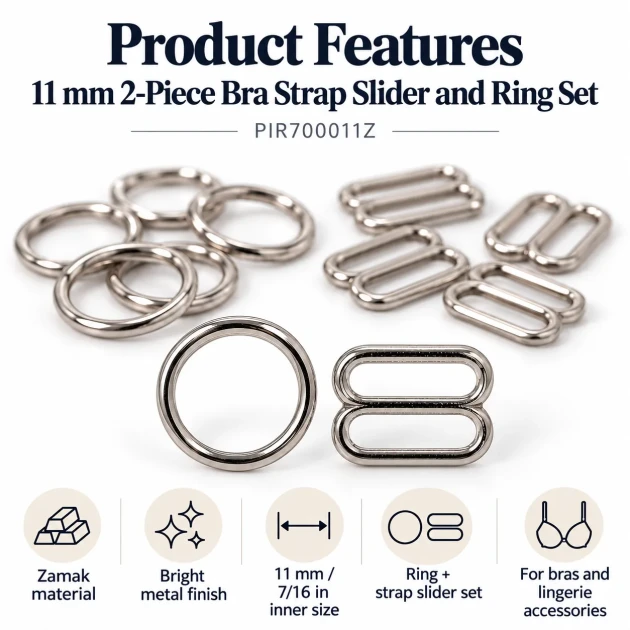
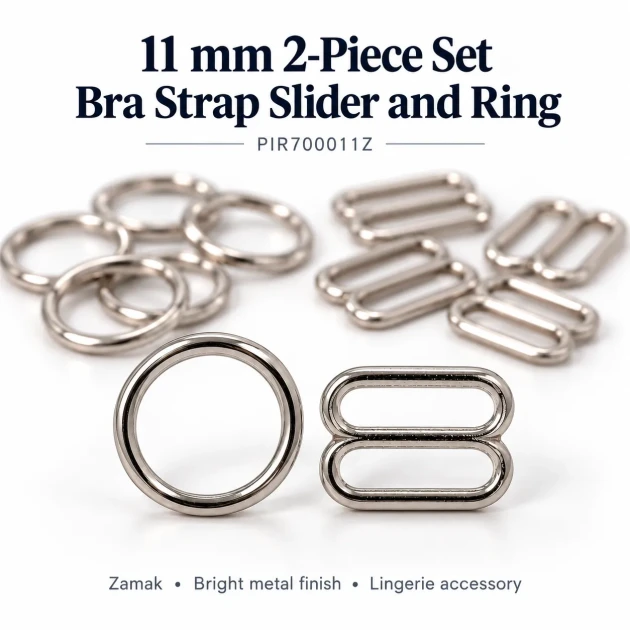
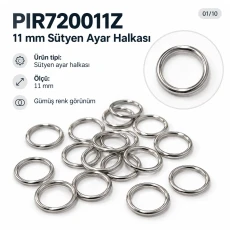
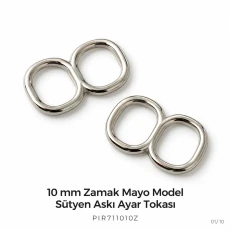
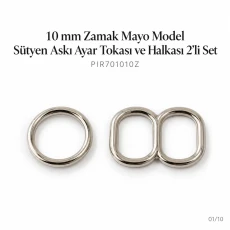
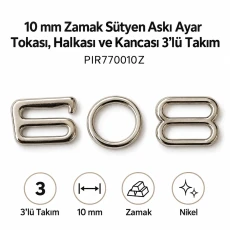
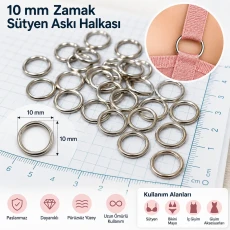
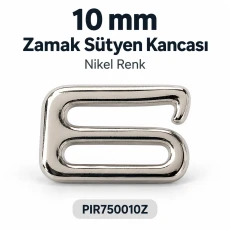
11 mm / 0.43 in Zamak Bra Strap Slider and Ring 2-Piece Set is a buckle, hook, or ring hardware listed by E-Buttons under Bra Rings, Hooks and Strap Adjustment Buckles. For correct selection, treat the nominal size as a starting point and evaluate it with the real material, mating component, and installation method used in production.
Selection and technical checks for 11 mm / 0.43 in Zamak Bra Strap Slider and Ring 2-Piece Set
Finish and color can appear different across screens, lighting, and production lots. When exact matching matters, approve a physical sample. If the material is not stated in the verified title or page data, do not infer the metal type from appearance alone.
After assembly, confirm that the strap moves without twisting, that seam bulk does not block the hardware, and that the hook or ring works in the intended orientation.
For buckles, rings, hooks, and strap adjusters, one of the most important dimensions is the clear opening used by the strap or cord. Two models with the same nominal size may have different outside geometry, wire section, or connection behavior, so test the actual strap.
Production sampling and quality-control approach
Color and surface finish should be evaluated after technical compatibility. Screen settings, photographic lighting, and natural lot variation can change how a finish appears. When zippers, buckles, buttons, eyelets, or other metal hardware must match within one collection, comparing physical samples side by side is more reliable than screen color alone.
The unit price of an accessory is not the only production cost. Wrong sizing, incompatible tooling, incorrect setting, or rework can create more expense than a small difference in component price. Purchasing teams can therefore treat technical review and sample approval as part of cost control rather than as separate administrative steps.
Commercial conditions can change over time. Current stock, price, color options, minimum order, and delivery information should be checked on the live page at the time of purchase. This description focuses on selection and verification instead of turning changeable commercial information into permanent technical claims.
Successful use in an earlier project does not automatically prove suitability in a new one. Fabric layers, strap thickness, cord braid, seam allowance, or connection orientation can change how the same hardware behaves. Critical connection points should be re-checked whenever the construction of the final product changes.
Press settings also affect results for hardware that uses setting tools. Even with the correct die, too much or too little pressure can leave surface marks, loose connections, or material deformation.
Checks to complete before bulk production
Using precise terminology reduces purchasing errors. A Punching Die and a Setting Die, inner size and outer size, product diameter and strap opening are different concepts. Purchase notes should state what the critical dimension actually measures instead of listing a number without context.
Traceability between warehouse and production is easier when the model code remains the primary identifier. When similar parts share storage areas or names, labels that include model, size, and approved color or finish help prevent mixing. This is especially useful for repeat orders within the same season.
Final-product inspection should look at more than whether the accessory can be attached. Depending on the item, review opening and closing, movement, friction, rotation, pulling on the fabric, or pressure on the seam. If the page does not publish a cycle-life value, the content should not promise a specific service life.
When considering an alternative model, compare more than price and appearance. Re-check the critical dimensions, connection point, stated material, and installation method. Products listed in the same category are not automatically direct replacements; a category indicates a related buying intent, while technical interchangeability requires separate verification.
Checks to complete before bulk production
Before bulk production, a final checklist should confirm the correct model, correct size, correct color or finish, correct mating component, and correct installation method on the same approved sample. Reviewing those points together provides a stronger purchasing basis than the product name alone.
When comparing similar-looking accessories, evaluate the product family, size, connection method, and function in the final item together. Two parts that look alike in a photo may differ in clear opening, barrel length, wire section, tooth construction, or backside geometry. Those differences matter most when the same small mismatch would be repeated across a production run.
Sampling may be a small step, but it is one of the most effective ways to reduce purchasing risk. Testing the part on the real fabric, strap, cord, or mating component lets size, assembly result, and appearance be reviewed together. Recording the approved model and critical dimension in the production file also reduces confusion on repeat orders.
Incoming inspection should include more than counting pieces. Random samples can be checked for visible surface condition, dimensional consistency, burrs or deformation, movement of functional parts, and connection with the mating component when applicable.
Two-piece set logic for e-buttons
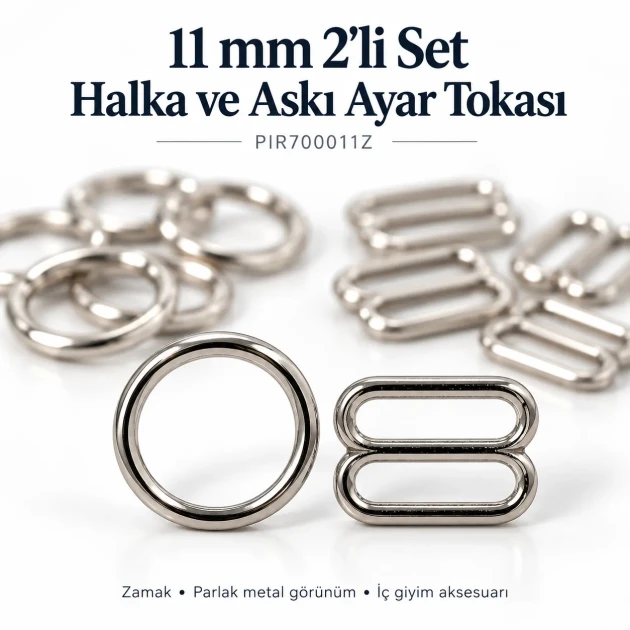
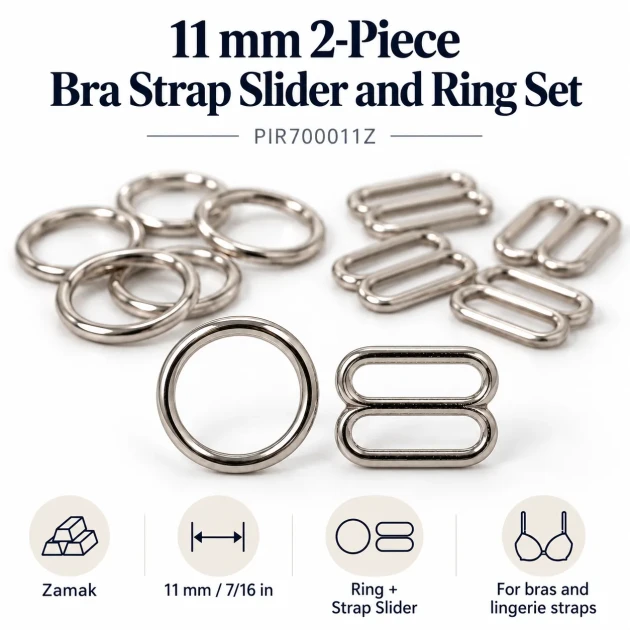
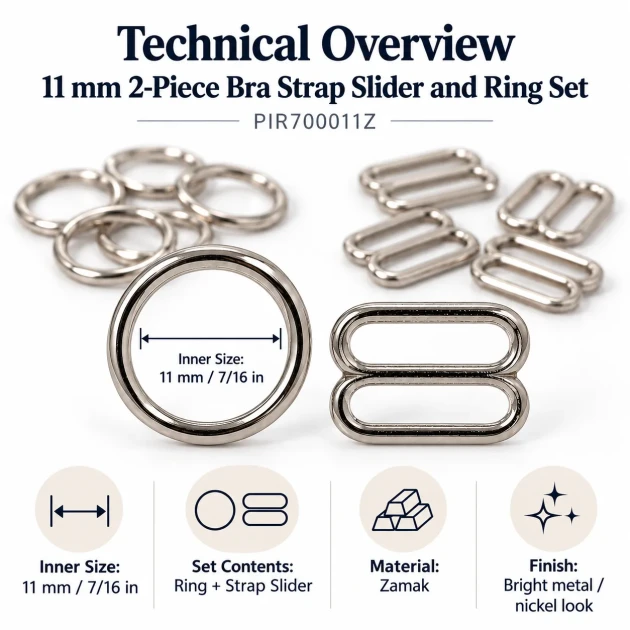
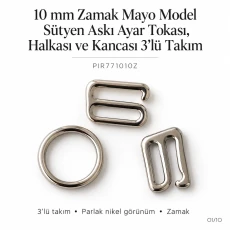
This 11 mm / 0.43 in Zamak set combines one bra strap slider and one ring in a single sales unit. It does not include a hook. That package distinction is important for production teams deciding between single components, a two-piece set and a three-piece set. The buying format should match the actual bill of materials and component consumption ratio.
Count sets and physical components separately
One sales unit contains two physical parts. Inventory planning should therefore distinguish set quantity from individual component quantity. When a style uses more than one strap assembly per garment, demand should be calculated from the completed garment construction rather than from the number printed on the package alone.
Sample both components with the production tape
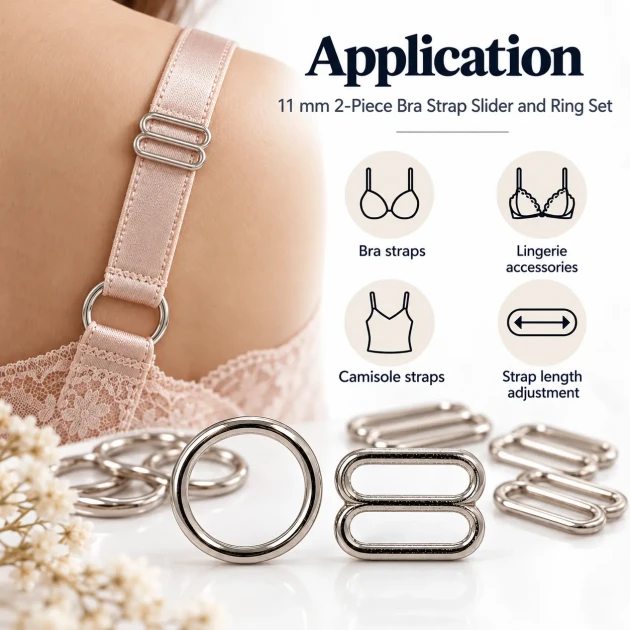
Run the actual tape through the slider and assemble the ring connection on the same sample. Check movement, fold thickness, seam placement and ring angle before approving the system. A nominal 11 mm / 0.43 in label identifies the family, but tape construction can change how the finished strap behaves.
When single components may be better
If sliders and rings are consumed at different rates across several styles, separate inventory can provide more flexibility. If they are consistently used together, the two-piece set can simplify picking. When a hook is also always required, compare the three-piece set instead of adding unrelated stock.
Repeat-order identification
For repeat orders, keep the component type, 11 mm / 0.43 in size family, Zamak material and two-piece package content together in purchasing and warehouse records. Clear identification reduces confusion with three-piece sets and other sizes that may look similar in storage.
First-run verification for the two-piece set
After sample approval, compare the first completed production straps with the reference. Confirm slider orientation, ring position, tape routing and stitch distance before the full order continues. A small change in tape lot or sewing method can alter the way the set behaves even when the nominal 11 mm / 0.43 in size is unchanged.
Using one set across multiple styles
If the same hardware set is shared across several sizes, colorways or garment styles, each construction should still be reviewed independently. Strap length, fold allowance and connection geometry may differ. Common inventory can simplify purchasing, but the technical sheet for each style should state the actual number of sets used and the approved assembly method.
Frequently Asked Questions
What should be checked first when selecting this product?
Review the product title, category, verified size information, and any stated material details together. Confirm fit with the real fabric, strap, cord, or mating component before bulk production.
Can another model with the same nominal size be substituted directly?
Not automatically. The same nominal size does not prove identical outside geometry, connection method, or installation system. Repeat sample validation when the model changes.
Will the color or finish look exactly like the screen image?
Screen and lighting conditions can change color perception. Physical samples or same-lot approval are more reliable when exact matching is important.
Why is a sample recommended before bulk production?
A sample lets you review size, assembly result, appearance, and movement in the final construction at the same time, helping prevent a small mismatch from being repeated at high volume.
Why are live price and stock not written into the description?
Price, stock, and commercial options can change, so they should be checked on the live E-Buttons product page when the order is placed.
Where the 11 mm / 0.43 in 2-piece set fits in the bill of materials
This 2-piece format on e-buttons combines one bra strap slider and one ring in a single sales unit. It can simplify purchasing and warehouse picking when both parts are consistently consumed in the same ratio. If the garment uses different quantities of sliders and rings, separate components may offer more inventory flexibility. The best buying format should follow the real bill of materials rather than package convenience alone.
Sample both components with the same production tape
Slider movement and ring orientation should be checked together on the actual strap construction. The nominal 11 mm / 0.43 in size identifies the family, while tape thickness, stretch, fold construction and seam placement determine real behavior. Move the slider through several positions and inspect the ring angle at the same time. Look for twisting, bunching, binding or excess play before releasing the combination for production.
Technical-sheet and warehouse separation
The technical sheet should state clearly that one sales unit contains two physical components. Warehouse labeling should use the same description and keep set inventory separate from single-slider and single-ring stock. Repeat orders are safer when component type, nominal size and material remain consistent across purchase orders, technical sheets and bin labels. An approved physical sample or clear reference image can provide an additional check.
Production planning and repeat orders
Total requirement depends on the number of sets used per finished garment and the production quantity. A style with two complete strap systems may consume more sets than a single-strap design. If several sizes or colorways use the same approved set, demand can be consolidated. Sample pieces and quality-control requirements should also be considered according to the manufacturer's internal planning method.