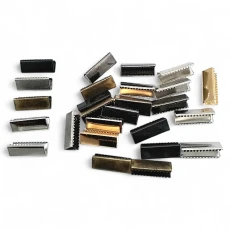
What Is a Cord End or Drawstring Tip?
A cord end is a fixed terminal accessory fitted to the cut end of a cord, drawstring, lace, compatible elastic or narrow strip. According to its design, it may cover the terminal section, conceal a knot, clamp the material or provide a visible metal or plastic finishing detail.
A cord end does not adjust the working length of a drawstring. Where movable adjustment is required, use a cord lock or drawstring stopper. Both component types may be used together on a hood, waistband, bag or footwear cord.
Which Cord End Should Be Selected?
| Application Requirement | Model to Consider | Specification to Check |
|---|
| Finish a round cord | Cylindrical, conical, cube, bead or another round-entry cord end | Actual and lightly compressed cord diameter |
| Conceal a knot inside the component | Pass-through or knot-retained cord end | Internal cavity and completed knot dimensions |
| Finish flat cord or narrow webbing | Open-edge or closed-edge crimp cord end | Material width, thickness and folded terminal construction |
| Minimise component weight | Plastic cord end | Entry structure, closure system, colour and body dimensions |
| Create visible metal hardware | Brass, zinc alloy, sheet-metal, iron or another verified metal model | Base material, finish, fitting method and component weight |
| Bond the cord inside a cavity | Bond-on cord end | Internal opening and adhesive compatibility with both materials |
| Secure the component by stitching | Sew-on cord end | Sewing area, thread, cord thickness and pulling direction |
| Close two lightweight sections around the cord | Interlocking plastic cord end | Complete closure and retention under pulling force |
Metal and Plastic Cord-End Categories
Metal Cord Ends
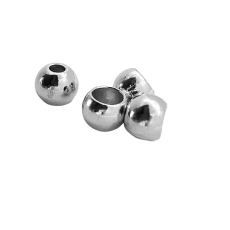
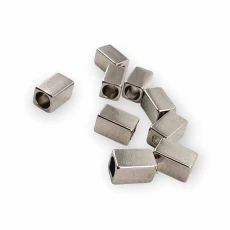
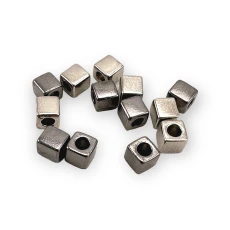
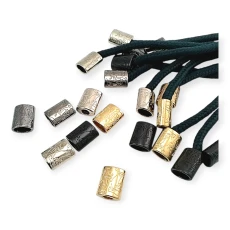
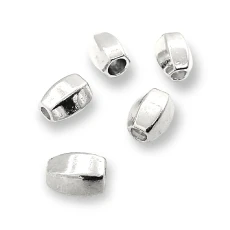
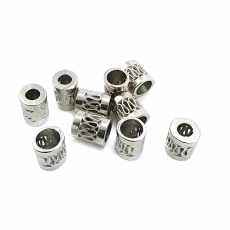
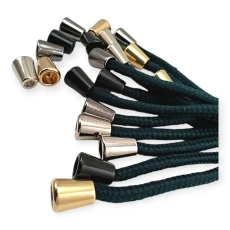
Metal cord ends may be manufactured from brass, zinc alloy, sheet metal, iron or another metal stated on the individual product page. Open-edge and closed-edge crimp ends, bond-on models, cylinders, cubes, bells, beads and other decorative body shapes may be found within this group.
Metal models may be selected when the cord end is intended to remain visible, coordinate with other plated components or create a more substantial finishing detail.
Plastic Cord Ends
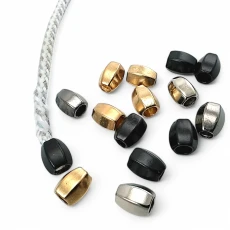
Plastic cord ends may be suitable where low weight, colour matching and practical assembly are priorities. The range includes crimp-on, interlocking, capped and model-specific plastic tips with different entry arrangements.
A plastic body does not experience metal corrosion, but wash temperature, chemical exposure, heat and outdoor suitability must still be evaluated according to the verified polymer and complete component construction.
Cord-End Fitting Methods
| Fitting Method | How It Works | Application Check |
|---|
| Crimp-on | The metal or plastic body is closed around a cord, tape or strap. | Check the internal opening, material thickness and required closing pressure. |
| Knot-retained | The cord passes through the component and is retained by a knot inside or behind it. | Confirm that the finished knot fits inside the available cavity. |
| Pass-through | The cord passes through an internal channel and is retained according to the body structure. | A sealed end, knot or added component may change the assembly sequence. |
| Bond-on | The cord is fixed inside the component with an appropriate adhesive system. | The adhesive must be compatible with the cord, finish and base material. |
| Sew-on | A hole or sewing area is used to secure the component. | Assess thread thickness, sewing area and the direction of applied force. |
| Interlocking | Inner and outer plastic sections close around the cord end. | Confirm full closure and resistance to separation on a sample. |
Open-Edge and Closed-Edge Crimp Cord Ends
An open-edge crimp cord end has side sections that are folded around cord, webbing or strap. The position of the material can usually be observed more easily before crimping.
A closed-edge crimp cord end surrounds more of the terminal section. The material is placed inside the verified internal opening before the body is closed with controlled pressure.
A closed-edge construction does not automatically provide stronger retention. Holding performance depends on internal width, internal height, base-metal structure, material thickness and crimping force.
How to Determine the Correct Cord-End Size
The nominal size stated by a cord supplier may not represent the actual dimensions at every point. Measure the material with a caliper and include a lightly compressed measurement for soft or filled cords.
| Measurement | Why It Matters | How to Check It |
|---|
| Outside round-cord diameter | Determines whether the cord can enter the component. | Measure several points without flattening the cord. |
| Compressed diameter | Shows how much a soft cord narrows during closing or crimping. | Compare normal and lightly compressed measurements. |
| Flat-cord or webbing width | Must correspond with the verified internal width. | Do not use the decorative outside body as the compatibility measurement. |
| Flat-cord or webbing thickness | Affects whether the closure is insufficient or excessive. | Include folded or overlapping terminal sections. |
| Completed knot dimensions | The knot must fit inside a knot-retained body. | Prepare and test the actual knot intended for production. |
| Internal component opening | Defines the usable cord or webbing capacity. | Do not confuse it with the total length or outside diameter. |
Common Cord-Entry Groups
The following metric and imperial measurements are general selection references. Use the verified internal opening on the individual product page for final approval.
| Entry Size | General Application | Compatibility Check |
|---|
| 2.5–3.5 mm / 0.10–0.14 in | Fine strings, narrow laces and small decorative cords | Check whether a sealed, cut or knotted section can enter. |
| 4–4.5 mm / 0.16–0.18 in | Lightweight garment and accessory cords | Check braid density and compressibility. |
| 5–5.8 mm / 0.20–0.23 in | Hoodies, bags and medium-weight drawstrings | Confirm secure retention after installation. |
| 6–7.5 mm / 0.24–0.30 in | Filled cords, thicker laces and decorative applications | Check whether the cord or completed knot fits inside the cavity. |
| 8–9.2 mm / 0.31–0.36 in | Thick cords and components requiring a larger internal cavity | Evaluate component weight and scale on the finished product. |
| 8 × 3 mm / 0.31 × 0.12 in and 10.5 × 3 mm / 0.41 × 0.12 in rectangular entries | Flat cord, narrow webbing and compatible strap ends | Measure width and thickness separately. |
Two cords carrying the same nominal size may behave differently in the same cord end. Braid density, filler hardness, elasticity and surface construction must be considered.
Metal and Plastic Cord Ends Compared
| Feature | Metal Cord End | Plastic Cord End |
|---|
| Base material | Brass, zinc alloy, sheet metal, iron or another metal stated on the product page | Plastic or another polymer stated on the product page |
| Weight | May create a heavier and more visible hardware detail. | Adds less weight to lightweight fabrics and cords. |
| Appearance | Nickel, black nickel, gold, antique brass, black oxide and model-specific finishes may be available. | Black, white, coloured, transparent, paintable or model-specific surfaces may be available. |
| Fitting structures | Crimp-on, knot-retained, sew-on, bond-on or pass-through structures may be available. | Crimp-on, knot-retained, capped or interlocking structures may be available. |
| Typical selection reason | Visible metal hardware, finish coordination and decorative detail | Low weight, colour matching and practical assembly |
A metallic colour or plated surface does not prove that the cord end is made from stainless steel or suitable for saltwater exposure. Verify the exact base material and finish on the individual product page.
Cord Ends and Cord Locks Are Different Components
| Feature | Cord End / Drawstring Tip | Cord Lock / Drawstring Stopper |
|---|
| Main function | Finishes the cut end of a cord. | Adjusts the working length or gathering. |
| Position | Installed at the terminal section. | Positioned along the cord. |
| Movement | Normally remains fixed after fitting. | Can be released and repositioned. |
| Combined use | A cord lock may provide adjustment while cord ends finish the terminal sections of the same drawstring. |
Real-World Applications
- Hoodie, coat and jacket drawstring ends
- Tracksuit, shorts, trouser and waistband cords
- Bag, backpack, pouch and drawstring-sack cords
- Shoe, boot and trainer laces
- Hat, headwear and neck-warmer cords
- Narrow webbing, straps and compatible leather or PU strips
- Craft, jewellery and decorative cord applications
- Compatible round-elastic ends
Recommended Assembly Sequence
- Measure the round-cord diameter or both dimensions of flat material.
- Thread any required cord lock onto the cord before fitting the terminal component.
- Pass the cord through the garment casing, bag channel or eyelet.
- Set the final working length and terminal allowance.
- Complete the required cutting, sealing or knotting process.
- Fit the cord end using its verified crimping, sewing, bonding or interlocking method.
- Complete pull, movement and appearance checks.
Incorrect Selection and Assembly Warnings
- A cord end and a cord lock do not perform the same function.
- An opening that is too small may prevent insertion or damage the cord surface.
- An opening that is too large may prevent secure retention.
- Measure both width and thickness when specifying flat cord or webbing.
- Check the compressed diameter of soft and filled cords.
- Excessive crimping pressure may crush the cord or deform the metal body.
- An unsuitable adhesive may damage the cord, finish or plastic component.
- A completed cord end may not pass through a cord-lock channel.
- Finish colour alone does not verify the base metal or corrosion resistance.
- Small-part and detachment risks must be assessed separately for children’s products.
- Complete a sample installation with the actual cord before wholesale ordering or mass production.
Related E-Buttons Categories
Frequently Asked Questions About Cord Ends
What is a cord end and what does it do?
A cord end is a fixed terminal accessory used to cover, contain or decoratively finish the cut end of a cord, drawstring, lace or compatible narrow strip.
What is the difference between a cord end and a cord lock?
A cord end finishes the terminal section. A cord lock moves along the cord and helps adjust its working length or gathering.
How do I select the correct cord-end size?
Measure the outside diameter of round cord. For flat cord, tape or webbing, measure both width and thickness and compare them with the internal component opening.
Is matching the nominal cord and entry size sufficient?
No. Braid density, filling hardness and compressibility can change compatibility. Complete a sample test with the actual cord.
How is a metal cord end fitted?
The method depends on the model. Metal cord ends may be crimped, retained by a knot, sewn, bonded or fitted through a pass-through structure.
How is a plastic cord end fitted?
Depending on the model, a plastic cord end may be crimped, retained by a knot or assembled by closing interlocking inner and outer sections.
Does a crimp cord end require a press?
The required tool depends on the component dimensions, material and production quantity. Some models may be closed with controlled hand tools, while repeatable production may require a suitable crimping fixture.
Which measurements are required for flat cord?
Measure the width and thickness of flat cord, webbing or tape separately. Include any folded or overlapping terminal section.
Should the cord lock or cord end be installed first?
If the completed cord end is larger than the cord-lock channel, thread the cord lock first and install the cord end after completing the cord route.
Are all metal cord ends stainless?
No. Cord ends may be made from brass, zinc alloy, sheet metal, iron or another metal. Verify the exact base material and finish on the individual product page.
Is sample testing necessary before wholesale production?
Yes. A sample confirms entry fit, fitting method, retention, weight, finish and appearance on the completed product.
Last updated: 21 July 2026
Business and brand: E-Buttons – Istanbul, Türkiye
Technical verification note: Refer to the individual product page for exact metric and imperial dimensions, base material, finish, pack quantity and fitting method.

.jpg-40x40.webp "Magnetic Snaps Buttons")

.jpg-40x40.webp "Prong Snap Fasteners for Baby Clothes")


.jpg-40x40.webp "Curved Snaps Buttons")


.jpg-40x40.webp "Snap Fasteners Half Dome type")
-no5-k0010%20(3).jpg-40x40.webp "Eyetlets")


-K0014.png-40x40.webp "Steel Eyelets and Iron Metal Grommets")

.jpg-40x40.webp "Flat Brass Eyelets and Grommets")

.jpg-40x40.webp "Aluminum Eyelets and Grommets")


.jpg-40x40.webp "Galvanized Eyelets and Grommets")


.jpg-40x40.webp "Hole Cutter Tools and Punching Dies")

.jpg-40x40.webp "Grommet Punching Dies")


.jpg-40x40.webp "Pearls Types")


.jpg-40x40.webp "Rivets")


.jpg-40x40.webp "Water-Repellent Jacket Zippers")


.jpg-40x40.webp "Tires")

.jpg-40x40.webp "Round Braided Elastic Cord")


.png-40x40.webp "Enameled Buttons")


.jpg-40x40.webp "Carabiner Clips, Snap Hooks and Bag Hooks")


-PhotoRoom.png-40x40.webp "Spring Rings, Key Rings and Snap Clamps")


.png-40x40.webp "Hook and Eye Closures Sew-On")


.jpg-230x230.webp "Metal Cord End 5 mm Cord Entry Flower Patterned and Aesthetic Design E 1319")
.jpg-230x230.webp "Pinch Cord End 10 mm x 8 mm - Open Edge Pinch Cord End Brass DGK0010")
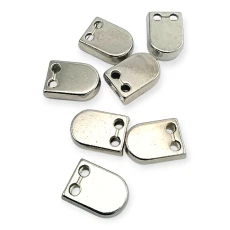
.jpg-230x230.webp "Sewn Cord Ends 9.5 x 8 mm Entry 6.5 mm - 0,25\" E 1458")
.jpg-230x230.webp "Metal Cord End Thick - Cylinder Model 4.8 mm Cord Input E 1333")
.jpg-230x230.webp "Cord End Pinch 14 mm x 7 mm - Brass Open Edge Pinch Cord End DGK0015")